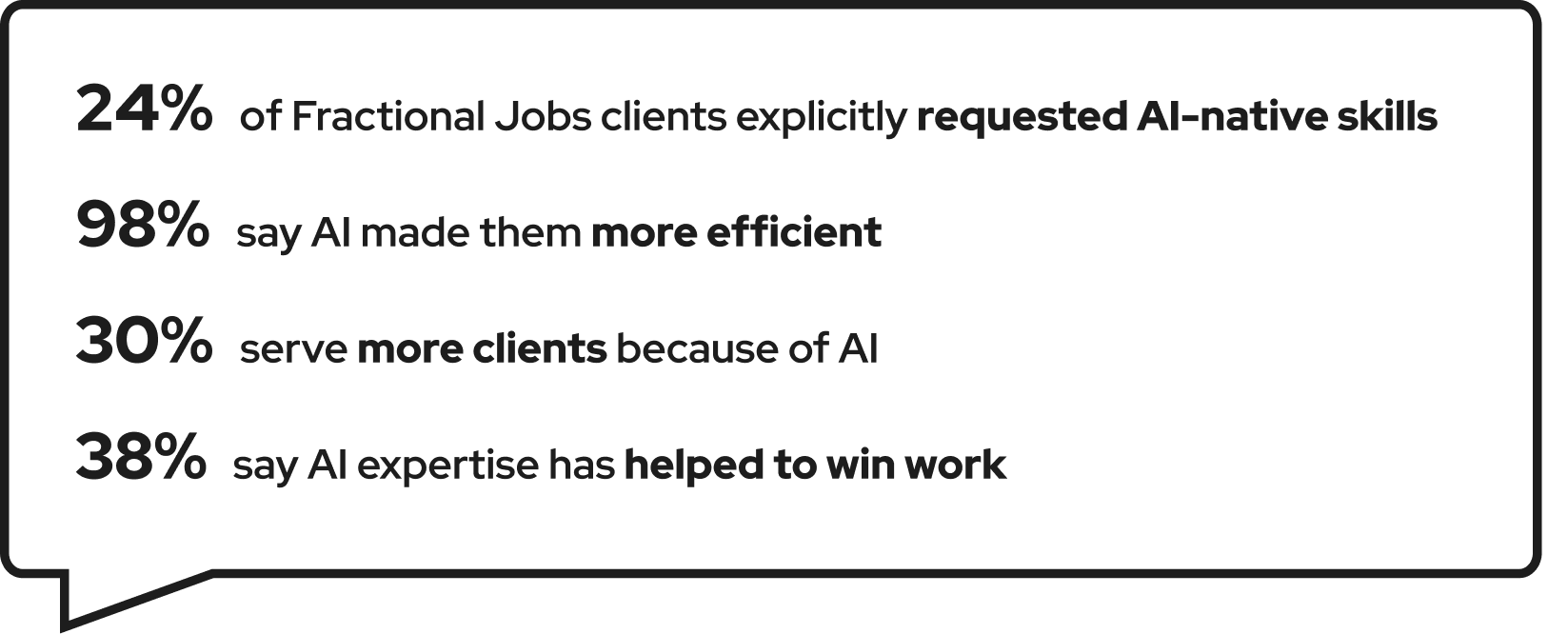
How AI is reshaping fractional work
What is the future for fractional work?
FAQ
What is fractional work?
Fractional work is part-time work, typically paid on a monthly retainer, and performed by experts in their field.
The part-time work part is obvious. This means that fractional jobs involve a smaller time commitment than a full-time job (typically 40 hrs / week). Fractional jobs are often for 5, 10, 15, 20, or 25 hrs / week.
A monthly retainer is the most popular form of compensation for fractional work, though a simple hourly rate is common too. This retainer reinforces the idea that a fractional job is meant to be ongoing and continuous, as opposed to a fixed project.
Fractional work is done by experts, and this is the key differentiator compared to other forms of part-time work like freelance work. Fractional leaders have honed their craft over many years (usually 10+), allowing them to drop into other companies and add immense value quickly and efficiently.
Link to this question
What is Fractional Jobs?
Fractional Jobs is the largest talent network for fractional leaders and the companies looking to hire them.
For fractional executives and other fractional talent, Fractional Jobs offers the Playbooks to break into fractional work successfully, the Tools to help you run your fractional business, and of course, the jobs. Every week we’re launching new jobs across 10+ function areas on our website and in our newsletter.
For startups, SMBs, and other companies that want to hire fractional talent, Fractional Jobs will help you find the perfect fractional for your need. You’ll tell us who you’re looking for, we’ll connect you to the best candidates, and you can hire them directly (we are not a middleman or an agency, and we don’t charge % markups).
Learn more about the benefits of letting Fractional Jobs help you hire fractional.
Link to this question
How is fractional work different from part-time, freelance, or consulting?
Fractional work refers to high-skill, strategic roles filled by experts who integrate deeply with a company on a part-time basis.
Unlike freelance or consulting, fractional roles are embedded into the company and often tied to core business outcomes. They’re better compared to part-time versions of full-time roles, delivering similar impact and accountability, but with fewer hours and without the long-term commitment of a full-time hire.
By contrast, freelancers are typically more junior and execution-focused: they handle discrete tasks or deliverables, work outside the org chart, and aren’t expected to set strategy or own KPIs. Consultants provide external advice or audits, usually short-term, and exit once recommendations are delivered.
Link to this question
Why is fractional work becoming more popular?
Fractional work has exploded in recent years, because it gives companies access to high-caliber talent without the cost or commitment of a full-time hire.
Remote work has made it easier than ever to plug in strategic talent from anywhere in the world. Combine that with economic pressure, hiring hesitancy, and the rise of flexible work models, fractional has become a no-brainer for companies that want senior impact without the overhead.
Most importantly, here at Fractional Jobs we’ve been supercharging this transition by making the fractional hiring process as frictionless as possible. What used to require expensive agency searches or tapping into your personal network can now be handled by our dedicated talent marketplace which operates the largest network of fractional talent in the U.S. and beyond.
Read more about the market shifts that have driven the surge in fractional work.
Link to this question
How is fractional talent typically compensated?
Fractional talent is typically compensated via a monthly retainer or an hourly rate.
A monthly retainer is a fixed fee paid each month for a defined scope or a set number of hours. It creates predictability for both sides, and makes it easy for the work to be ongoing.
A simple hourly rate is also a common arrangement, especially when associated with a minimum or maximum number of hours.
Compensation levels generally reflect the expert’s seniority and specialized expertise. Fractional roles are well-compensated, but compared to a full-time hire they cost much less because of the part-time nature of the engagement. Alternative payment agreements (e.g. commission, equity) are less common, but can be negotiated and may apply based on the type of role.
Read more about Fractional compensation for sales leaders.
Read more about how fractional work can actually lead to higher earnings.
Link to this question
Is fractional work done remotely or in-person?
Fractional work is most commonly done remotely. However, hybrid work and even on-site work can happen as well. It’s entirely up to both parties.
Link to this question
What are the most common fractional roles?
The most common fractional roles are Fractional CFOs, Fractional CMOs, and Fractional CTOs, according to Fractional Jobs’ proprietary marketplace data.
However, fractional roles exist in just about every function area. Fractional Sales, Operations, Product, HR, Security, Design, Customer Success, Legal, you name it.
Some fractional roles are more popular than others today because certain company needs are more obvious than others to require outside expertise.
Link to this question
How long does a fractional engagement typically last?
A fractional engagement can last anywhere from a few months to a few years, although the sweet spot tends to be 6 months to 2 years.
High-growth startups tend to need a fractional for less time, on average 6 months to 1 year, because as they grow the fractional need will more quickly turn into a full-time need.
Small businesses, since they grow more slowly, will often work with a fractional for 1 - 2 years.
In all cases, when the fractional relationship is coming to an end, it's common for the fractional to help the company hire the right full-time person. And, it’s not uncommon for the fractional to actually join the company full-time too!
Link to this question
What does a typical contract look like for fractional work?
Almost all fractional contracts are versions of Independent Contractor agreements (1099s).
They follow a simple, flexible format, usually month-to-month, with clearly defined hours (e.g. 10 per week), a monthly retainer or hourly rate, and a 15–30 day notice period for cancellation. NDAs and IP protection clauses are common, especially for strategic roles.
The key is mutual clarity: define what success looks like, how time will be used, and how either party can exit.
Read more about additional considerations when signing fractional work agreements.
Link to this question
What use cases are best suited for fractional work?
Fractional work is best suited for companies that don’t have the need for, or the budget for, a full-time strategic hire.
Common examples include leadership of a function area that doesn’t need a full-time exec (e.g. a Fractional CFO), launching a new initiative that requires a different kind of expertise (e.g. a Fractional Head of Partnerships), a really tough set of challenges that requires someone who’s been-there-done-that, accelerating go-to-market plans, or guiding a major operational change.
Link to this question
About Fractional Jobs
They then triangulated those findings against every major public source on fractional and independent work, including the U.S. Bureau of Labor Statistics, MBO Partners, Pew Research, and McKinsey. Fractional Jobs provided data and input throughout the process, but the analysis was conducted and written independently. The result is the most comprehensive view of the U.S. fractional market available today.
Platform Data
Original survey
External Sources
About Fractional Jobs
For companies, get introduced to the best candidates for your need, no matter the industry, skillset, or niche. Hire them directly, too (not through us). Learn more here.
For fractionals, build a successful fractional practice through our playbooks, our toolkit, and through introductions to potential clients. Learn more here.
HEY COMPANIES,
You’ll be speaking with Fractional Jobs founder
.png)
.png)
You’ll be working with Fractional Jobs founder
.png)
x
Live Jobs
Filter Jobs
%20(1).webp)
No jobs... yet. Get emailed when the next one goes live.
This is a spam-free zone.
%20(1).webp)
Fractional Job Alerts
In Your Inbox
Weekly.
This is a spam-free zone.
LEARN
Everything there is to know about doing fractional work.
The Complete Guide
In-depth Playbooks
The Toolkit
Our Blog
Contact Us
For Companies
Not ready for a call? Send us an email to start a conversation at
hello@fractionaljobs.io
For Talent
hello@fractionaljobs.io
For Partnerships
To learn more, send us an email to
hello@fractionaljobs.io
Fractional Jobs is the talent network for fractional leaders and the companies looking to hire them. For talent, we offer the resources to break into fractional work successfully, and introductions to potential clients. For companies, we’ll help you hire fractional talent across 10+ different function areas.
+ a fractional team of developers,
marketers, and more.