
Fractional Hiring by Job Function
Why is Fractional Work Growing So Quickly in Popularity?

It’s no secret that the fractional work trend is exploding. In hindsight, it will perhaps be obvious. The 40-hour workweek is a relic of the industrial age. Knowledge work is fundamentally different and companies are realizing that not all jobs need to be exactly 40 hours a week. Remote work is here. And top talent WANT fractional work.
Let’s look in more detail about all the main reasons why fractional work is growing in popularity.
Remote Work is Now Normal
Remote work is what has made all types of part-time work even possible, including freelance work and now fractional work. Teams can onboard senior operators quickly from anywhere, and fractional workers can pick up multiple clients without having to commute into three different offices.
Companies Are Prioritizing Flexibility
One major benefit of fractional work for companies is that it’s far more flexible than a full-time arrangement. And, it’s far more cost effective. For companies where this matters, hiring a fractional leader is a brand new option that is incredibly attractive.
The Best Talent Want Fractional Roles
Senior operators increasingly prefer fractional careers. Experienced CMOs, CFOs, CTOs, and senior ICs want flexibility, stacking clients to match or exceed full‑time comp while focusing on the high‑leverage work they’re best at.
The best talent can actually make more money doing fractional work, they can choose their clients, and even prioritize their personal life in ways not possible with full-time work.
And as more people flock to fractional work, companies that are hiring fractional benefit from getting their pick of the litter in terms of expert talent.
A Much Quicker Hiring Process
Dedicated fractional networks and platforms make it easy to find vetted leaders fast, opening access beyond traditional agencies and broad freelance marketplaces. Hiring a full-time CFO could take 6+ months. Hiring a Fractional CFO might take 6 days.
Even companies that would prefer a full-time hire, are sometimes hiring a fractional executive instead because they need someone immediately and fractional is the fastest way to get someone great.
Bottom Line
Mentions of “fractional” in professional profiles have grown dramatically in recent years, reflecting mainstream awareness and demand for embedded, part‑time leadership.
Fractional work is growing because it’s a more flexible relationship, it’s cost-saving for companies, but at the same time a highly attractive working model for senior operators.
How to Provide Weekly Updates to Your Fractional Clients
A weekly update is not required, so use your judgement on whether to incorporate this into your practice, but it can prove very helpful and well-worth the time investment.
Why Weekly Updates Matter
Because it’s a consistent reminder of your value. Fractional work is still relatively new. “Can they really move the needle on just 10 hrs / week?” It’s a common concern among founders / hirers.
Your contract is also probably a month-to-month engagement, which means its constantly up for renewal or termination. Weekly updates help you:
- Show consistent progress even when you are not full-time
- Build confidence with stakeholders who may feel concerned about fractional work
- Surface blockers early so issues are resolved before they become bigger problems
- Reinforce why your involvement continues to be valuable
When done well, updates reduce anxiety for clients and show real value on a continuous basis.
What to Include in a Weekly Update
A strong weekly update is simple to read and quickly shows your value. It should take no more than a few minutes for you to write and a few minutes for your client to read.
The most effective summaries contain these three core sections:
- What happened this week - Briefly list the key work completed or progress made.
- What’s next - Highlight priorities for the upcoming week so clients know what to expect (and can re-prioritize if needed).
- Ask or decision needed - Flag any input you need to keep moving without delays.
An Example Weekly Update
Here’s a real example from Fractional Jobs founder Taylor Crane, during his time as a Fractional Head of Product.
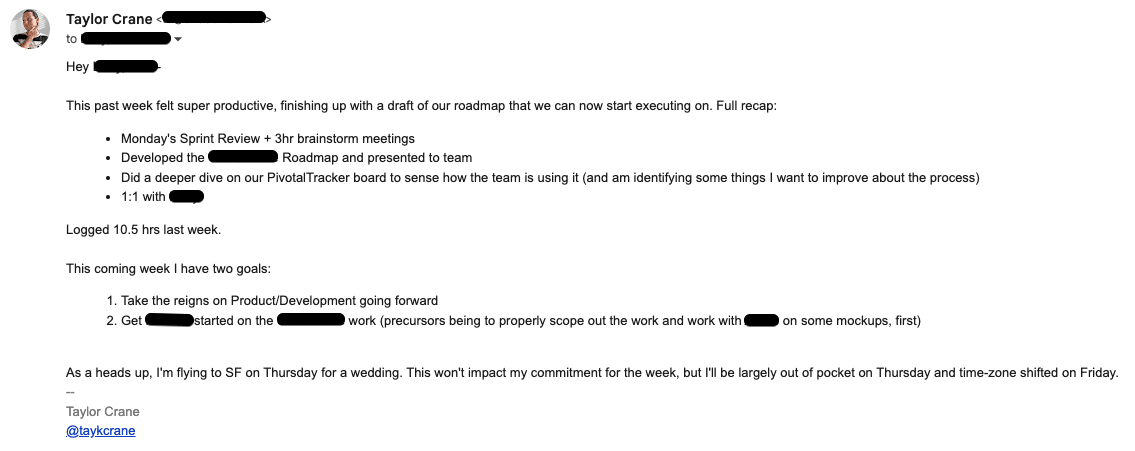
—
Again, not required, but suggested. Especially when you’re working with a new client and you want to build trust quickly. It takes a few minutes to write, and will increase the length and health of your client relationships.
Why Don’t I See any Fractional Roles for Me or My Function Area?
The Most Popular Fractional Roles, and Why
Many companies often hire fractionally in comfortable, well-understood domains first. Functions like CFO, CMO, and CTO are very familiar titles with recognizable deliverables.
But that’s not the only reason they’re popular. It’s also because these tend to be the areas where its easy for a founder or business owner to say “I have this problem, and I need to bring in an expert to solve it.”
If a company has a need for strategic finance work, their first instinct is going to be to find a finance expert to solve it for them. However, if a company has a need for strategic operations work, the first instinct might be for the founder to do it themself, or have another team member step in.
The Less Popular Roles, and Why It’ll Change
Fractional roles in Product, Operations, Sales, HR, etc. are rising quickly in popularity, but not yet super popular. These are all examples of roles that we all know are common roles at companies, but company instincts tend to have them pull in other team members to try and solve these problems, or simply just go without solving them for a while, perhaps to their detriment.
Remember that fractional work is still very new. It’s going to take time for founders and business owners to understand its benefits, and they’re probably going to start with the more obvious roles first like CFOs or CMOs.
Fractional Needs Evolve As Companies Grow
Needs around expertise change as companies mature. Companies usually hire fractional in this pattern:
- Immediate operational needs first. Early on, companies focus on urgent gaps that clearly impact revenue or operations.
- Leadership and scaling comes next. As the companies grow, they bring in part-time experts to provide strategy and governance without the financial burden of a full-time hire.
- Deeper functions typically come later. Once fractional leadership for core roles proves valuable, companies will often expand into other areas like product, people operations, data, or legal.
This means some function areas simply haven’t reached the adoption threshold yet.
Job Postings Do Not Equal Demand
Just because a role isn’t posted on a job board like Fractional Jobs, does not mean it doesn’t exist. Many fractional engagements are filled through:
- Referrals and networks
- Founders or executives reaching out directly
- Rolling, informal conversations rather than public postings
In other words, demand may be there but it is just not yet frequent enough to gain visibility on places like job boards, Linkedin, or other places.
You Can Create Your Own Demand
If you do not see many fractional roles in your area, that doesn’t have to be the end of the story. Fractional work is still shaping itself, and individuals who take it upon themselves to do outbound outreach and define the value of their function can create demand. This is how most fractional leaders get their business, even for the most popular function areas.
Quick Summary
Not seeing fractional roles listed for your function area usually means the market has not fully matured in that space yet. It does not mean your skills are not valuable or that companies do not need what you do. Demand often starts off happening through networks, referrals, and direct outreach.
If you want a more in-depth understanding, read Taylor’s personal take on this question, including what he calls Level 1, Level 2, and Level 3 fractional hiring.
How to Create a Proposal for a Potential Fractional Client
This help article is geared towards folks that don’t have much experience pitching themselves, and need the basics of how to do it effectively.
NOTE: If you’re looking for a very thorough breakdown of everything that goes into a proposal, check out our Playbook instead called "The What, Why, and How of Creating a Proposal For a Fractional Client". This article below serves only as a high-level summary.
What is a Proposal
The proposal is a written document (or presentation) that outlines for your potential client what an engagement is going to look like.
It is NOT the legal contract. For that, read our contract best practices here.
The proposal phase of closing a new client is important as it serves to set mutual expectations about what the engagement is, and isn’t.
How to Put Together a Proposal
Before starting a proposal, you’ll typically have had one, probably two or more conversations with the client already. You should be using these conversations to fact-find about the client’s needs so that you can put together a proposal that’s relevant to them.
The basic steps to put put together a proposal are:
- Choose your preferred format - typically in an email body, a Google Doc, a Notion Doc, or a slide deck
- Decide what you want to include - we cover this down below
- Solicit the client’s feedback - Sending the proposal should be the start of a discussion
The proposal should be detailed enough to give the client a clear picture of what they’re buying. But, it should not be so detailed that it creates unnecessary rigidity in the relationship. Priorities and goals change constantly, a proposal that is too detailed can actually work against you.
Once everyone is aligned on the proposal, you’ll then sign a contract, which we cover here.
What to Include in the Proposal
There isn’t a single best practice for a proposal. Like many things about fractional and consulting work, it’s largely up to you. But there are some certain common items to include that will set you up for more success.
- A problem statement - Restate what you understand the core problems to be, why the client is coming to you in the first place.
- The scope of work - A clear, point-by-point, description of the work you plan to do.
- Timelines to deliver that scope
- Your time commitment, usually measured in hours per week or hours per month.
- Cost - This is your compensation. (If you need help figuring out what to charge, check out our resources on that HERE).
Below is an example proposal for Fractional CMO work. This proposal hits all of the key criteria for a successful proposal. Notably, it has a relatively vague scope of services. That’s okay! Especially if the client doesn’t quite know what they want. The deliverables are also a nice supplement the scope, and include a sense of timeline too.
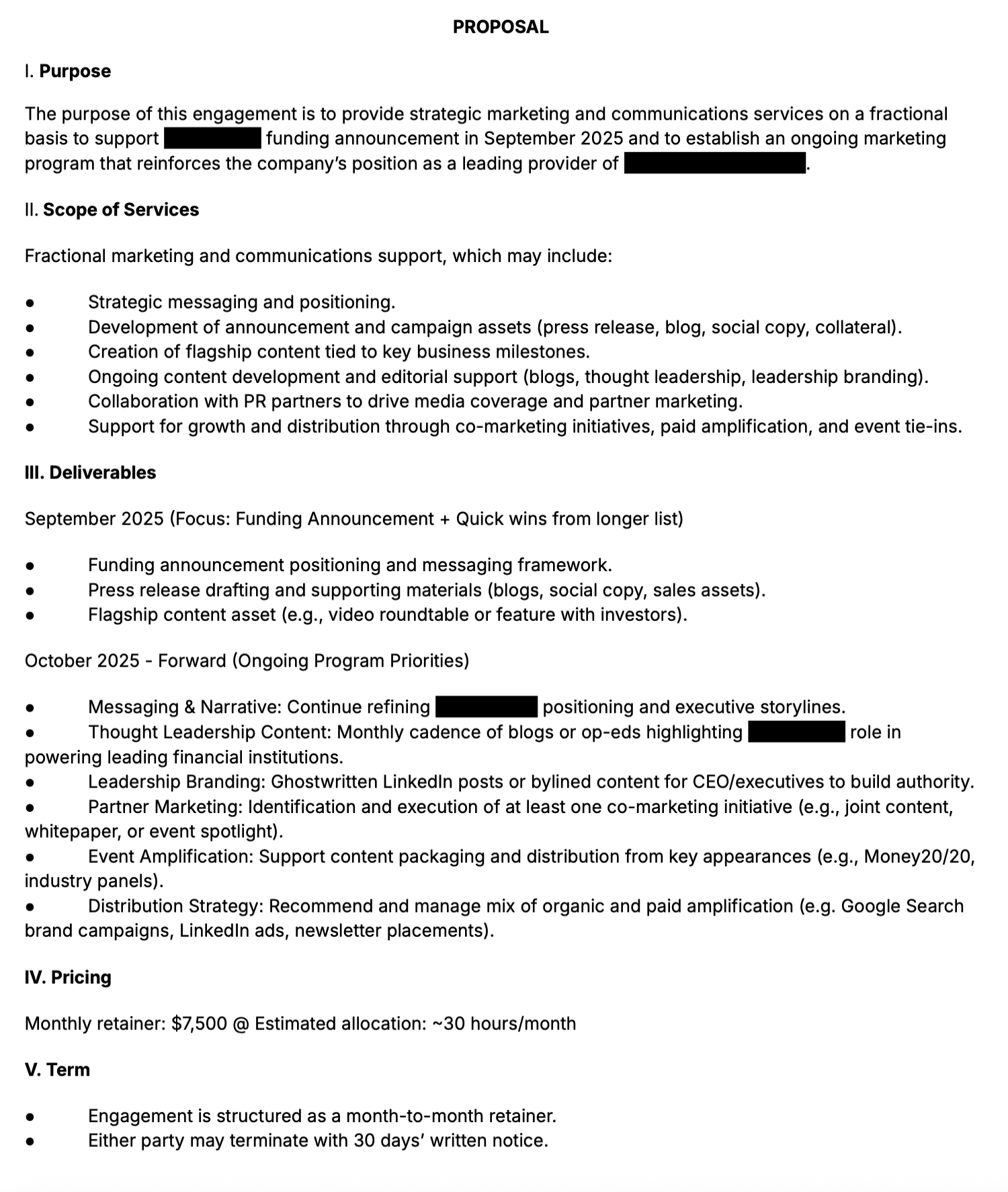
—
If you want a more detailed breakdown of how to put together an effective proposal, what to include, what NOT to do, and more proposal examples, check out our Playbook “The What, Why, and How of Creating a Proposal for a Fractional Client”.
How to Increase Your Rates
There are two primary ways to think about rate increases: with new clients and with existing clients.
Raising Rates for New Clients
The simplest way to increase your income is to raise rates for new clients going forward.
This approach avoids awkward conversations and allows your pricing to naturally evolve as your experience, reputation, and demand grow. As you get better at articulating your value and delivering outcomes, quoting higher rates becomes much easier and more defensible.
Many fractionals will step their rate up over time by:
- Increasing rates after a strong engagement or metric achieved
- Adjusting pricing as demand exceeds capacity
- Raising rates annually as a default practice
New clients anchor to the price you quote them. They do not know what past clients paid, which makes this the cleanest and lowest friction way to increase your rates.
Raising Rates for Existing Clients
Increasing rates for existing clients is more delicate but often necessary over long engagements.
The most important principle is giving the client advance notice. Three months is a good baseline, and more is better when possible. It is critical that rate increases never feel sudden or arbitrary.
The best rate increase conversations are paired with context. Perhaps you’re raising rates at the beginning of the new year, or when the company completes a large funding round that your work helped achieve. Or maybe you’re renegotiating your contract because the scope and responsibilities have materially changed.
Framing the increase around change helps clients understand the pricing is evolving with real reason behind it.
Specific Tactics and Language
- Grandfathered in - “I wanted to let you know that I’ve started onboarding new clients into my practice at a rate of $X. Don’t worry, you’re grandfathered in for now, but starting X months from now I’m going to be moving all existing clients to this new rate too.”
- Upcoming milestone - “Starting in the new year, I’ll be increasing my rates to X. I wanted to give you ample notice so we can prepare in the event that we need to adjust our engagement together.”
- Use a temporary discount at the start - “OK I’m happy to discount you to $8K / month to get the relationship going, but once you’ve raised your next round I’ll need to charge you my rate card of $10K / month”.
- Offer a choice - “Although my rates are increasing, there are a couple ways I think we can tweak the scope in order for me to be able to keep the rate the same.”
- Supply/demand - “A little bit of insight into my fractional practice, demand for my services continues to increase, and I’m starting to turn clients away. To adjust, I’m going to be increasing my rates for new clients starting now and for existing clients starting X.”
Tips to Keep in Mind
- Communicate early. Do not surprise your client with a sudden rate increase. Target at least 3 months notice. Even if your contract is technically expiring and re-negotiation is fair game, your client should not be made to believe they will be able to renew at the same rate.
- Be transparent about discounts. Giving a discount is a common thing to do, let your client know its a discount, and how much your normal rate is, because this gives you leverage to remove the discount in the future.
- Have a reason for the rate increase. It might be a company milestone, or a scope expansion, or even just supply-and-demand.
- Use renewal conversations. Formally negotiating a renewal, or after a natural ending/starting point, are both great times to have a rate increase conversation when needed, vs. e.g. right in the middle of a huge project.
- Be prepared for clients to say no. They might! And if so, are you comfortable walking away from the relationship?
- You’re not asking permission. This is different from full-time employment where you “ask” for a raise. Instead, you’re telling them what their new rates are, and they can either agree, negotiate, or decline.
- Own the transition plan. If the client does decline to continue working with you, you should work with them on an appropriate transition plan so that they aren’t left hanging. P.S. if you need a new fractional leader to replace yourself, Fractional Jobs can help.
In Summary
In fractional work, you have more control over your compensation. You set your own rates, and can therefore determine when those rates increase (or get discounted). Raising rates for new clients only is the easiest path. Raising rates for existing clients requires advanced notice, justification, and relationship management.
How Much Money Can I Make by Doing Fractional Work?
This article is meant to show what is possible, not what will automatically happen.
NOTE: If you’re looking for a more in-depth breakdown of how much money you can make doing fractional work, check out our Playbook here. This article serves as more of a high-level guide.
What Fractional Compensation Usually Looks Like
Fractional leaders are typically paid through monthly retainers, hourly billing, or a combination of base pay and incentives. Monthly retainers are the most common structure because they provide clarity around scope and predictability for both sides. For more details on this, read here.
Rule of Thumb to Calculate Your Hourly Rate
One rule of thumb is to take your most recent full time base salary, remove the last three zeros, and use that number as an approximate hourly rate. For example, someone earning $180,000 in a full-time role might start around $180 per hour. This is not a guaranteed rate, but should be treated more like a goal, something that you can eventually attain as you start building your fractional practice.
Monthly Retainers and Stacking Clients
A common monthly retainer structure might involve committing to around 10 hours per week for a single client at a fixed monthly rate. Most fractionals will work anywhere between 5-30 hours per week for a single client. Over time, some fractionals will stack on a second, third, or even more clients at different levels of time commitments.
This ability to stack multiple part-time engagements is what creates higher income potential, but it is important not to overcommit to work you don’t have time for.
What Realistic Income Ranges Look Like
Imagine your target hourly rate is $200 / hr. This would equate to a roughly $8,000 monthly retainer for a 10 hr per week commitment.
Although there are 40 hours in a “work week”, don’t make the mistake of thinking that all your working hours will be billable. You need to spend time managing the back-office of your business, as well as on finding new business.
It’s most common to spend about 25 or 30 hours of your week on client work.
So that might look like picking up two monthly retainers of $8,000 at 10 hours per week each. And then, perhaps picking up a third retainer, or a 5 hour per week engagement, or even a couple of 2 hour per week advisory engagements.
In this example, monthly income might look like $8K + $8K + $4K = $20K / month.
As you do great work, you can start to increase your rates and retainers, and as you get more efficient you might be able to start taking on more work. Both of these serve to increase your monthly income.
It is not uncommon for experienced fractional leaders to be making 50%+ more than what they were making in their previous full-time job.
In Summary
Fractional work offers the chance to take control of how you spend your time and skills to earn the highest income possible. It can be demanding and unpredictable at times, but for many people that tradeoff is worth it.
You might earn a few thousand dollars per month to start. You might eventually replace a full time salary. With experience, positioning, and the right clients, some people go on to earn more than they ever did in traditional roles. None of these outcomes are guaranteed, but they are possible.
For more details about how compensation varies by role, seniority, and commitment, take a look at our Playbook “How Much Money Can I Make as a Fractional Employee?”
How to Maximize Your Tax Savings Doing Fractional Work
In this article, we’ll cover:
- Why fractional work creates unique tax advantages
- How entity structure, like S Corps, impacts taxes as income grows
- What the DIY strategy looks like in practice
- What a done-for-you tax strategy looks like and why we recommend it
- How to decide which approach makes sense for your situation
Why Fractional Work Creates Tax Advantages
Fractional income is not a paycheck. It is business income. That distinction is what creates nearly all of the tax opportunities available to fractional professionals. When you earn business income, you gain control over:
- How income is categorized
- Which expenses reduce taxable income
- When taxes are paid
- How income is split between salary and profit
W-2 employees, by contrast, have taxes withheld automatically and limited flexibility to deduct expenses or plan around timing. Fractional work flips that and allows taxes to become something you can strategically plan for.
Entity Structure and Why S Corps Matter as Income Grows
You do not need a formal entity structure to begin fractional work. Many professionals start as sole proprietors or single-member LLCs. As income grows, entity choice becomes one of the most powerful tax levers available.
Once your fractional revenue gets close to $80,000, an LLC with S Corp tax treatment becomes one of the most impactful entity structures. The advantage comes from how income is classified:
- Part of income is paid as a reasonable salary (subject to payroll taxes)
- The remaining income is paid as profit distributions (not subject to payroll taxes)
This does not eliminate income tax, but rather the savings come specifically from reducing payroll taxes. If you want a deeper explanation of when this structure makes sense and how it works in practice, we cover that in in our article comparing LLCs and S Corps for fractional professionals.
Two Ways to Capture These Tax Benefits
Once you understand why the tax savings exist, the real decision is how you want to manage them. There are two viable approaches.
The DIY Strategy
The DIY strategy is where most fractionals start, and honestly, it works fine if you’re willing to stay on top of it and not earning much money yet. The tradeoff is consistency. Once you go fractional, your income is business income, which means every dollar coming in and every dollar going out matters. If you wait until the end of the year to sort it out, you will miss deductions and almost certainly pay more tax than you should. Tracking income and expenses as you go gives you real visibility into what’s deductible and makes quarterly taxes far less painful.
A major advantage of the DIY approach is the ability to deduct ordinary and necessary business expenses, including tools and software, professional services, travel and meals, education, and marketing costs. These deductions directly reduce taxable income, but only if they are properly documented. Equally important is planning for quarterly taxes. Unlike W-2 income, taxes are not withheld automatically, so estimating liability, setting aside cash throughout the year, and making timely estimated payments helps protect cash flow and avoid penalties.
You can also reduce taxes by using tax-advantaged accounts such as Solo 401(k)s, SEP IRAs, and eligible health savings accounts. These tools lower current taxable income while supporting long-term financial goals.
Finally, strategic timing of income and expenses can meaningfully impact when taxes are owed. Accelerating deductible expenses or deferring billing, when appropriate, does not change total earnings, but it can improve tax efficiency. The DIY strategy works best for fractionals who are willing to stay organized, plan ahead, and treat their practice like a business.
The Done-For-You Strategy (Our Recommendation)
Fractional professionals are paid for their time. Every hour spent managing bookkeeping, deductions, quarterly estimates, and compliance is an hour not spent billing clients. That’s why we recommend a done-for-you approach for most fractional professionals as income grows.
Instead of handling all of the above yourself, you delegate it to a platform designed specifically for independent and fractional work. Services like Collective automate and manage:
- Income and expense tracking
- Identification and documentation of deductions
- Quarterly tax calculations and payments
- Entity and S Corp optimization
- Ongoing tax planning as income changes
These services allow you to capture the tax advantages of fractional work without having to personally manage the back office. For many professionals, this tradeoff makes sense because time is literally money when you are billing clients.
In Summary
Fractional work creates tax advantages by turning income into business income. That unlocks deductions, timing flexibility, and entity structures that are unavailable in traditional employment.
You can manage these benefits yourself through a DIY approach, or you can use a done-for-you solution that allows you to focus on client work while the back office runs in the background. Both strategies work, but if your goal is to maximize earnings while minimizing distraction, the done-for-you approach is the one we recommend.
For a deeper look at entity setup and how structure impacts taxes, see our full playbook on the tax benefits of fractional work.
Do I Need to Set up an LLC, an S Corp, or Other Legal Entity?
The correct answer will depend on your stage. Let’s explore your different options, and you can determine which is right for you.
Starting Without a Business Entity
If you are experimenting with fractional work or working with a single client, operating as a “sole proprietor” (i.e. no formal legal entity) is often sufficient. This keeps things simple while you decide whether fractional work is something you want to pursue long term.
At this stage, the priority is learning how to deliver value and find clients. Adding legal tax complexity too early will slow you down more than it will help you.
When an LLC is a Good Next Step
Once fractional work is providing noticeable income and feels intentional, forming an LLC often makes sense.
While an LLC is not required, it can help separate personal and business finances, provide basic liability protection and tax advantages, and create a more professional setup for working with clients. It is relatively inexpensive to set up an LLC and easy to maintain, which makes it a practical step once fractional work becomes a larger part of everyday life and once you notice business expenses start to occur more often.
When an S Corp Becomes Worth It
As income increases, an LLC with S Corp tax treatment is generally the most effective structure.
A common rule of thumb for when it is time to set up S Corp tax treatment is when you expect to earn $80,000 or more per year from your fractional work. At that level, the tax saving start to outweigh the added complexity.
The S Corp election is what unlocks most of the added tax benefits by allowing income to be split between salary and profit distributions. Profit distributions are taxed at a lower rate than salary which is why many fractionals prefer to have this setup. This does require payroll and ongoing compliance, which is why it works best once income is higher and more predictable.
Getting Support As You Scale
When you reach the point where an LLC plus S Corp makes sense, many fractionals work with services like Collective to handle setup, payroll, and compliance. The right support can make the process straightforward and reduce ongoing administrative work.
Collective is part of the Fractional Jobs Toolkit, and we recommend them to fractionals ready for S Corp status. They also have an LLC-only tier, which is super helpful for folks just getting started.
In Summary
While there is no single correct setup for every fractional professional, many prefer to open an LLC as the work becomes more consistent, and later move to an LLC with S Corp treatment when annual income surpasses the $80,000 mark. No entity is required to begin fractional work, but is rather a tool to support growth and tax savings over time.
Learn more about the tax benefits of fractional work in our Playbook here.
Should I Charge an Hourly Rate, a Monthly Retainer, or Something Else?
Hourly Rates
Hourly rates are a common and simple compensation method for fractional work, especially when first starting out.
Pros:
- Super simple for both parties to understand
- Easy to sell into the client (because of its simplicity)
- A great way to see how long work actually takes, test pricing assumptions, and ease into fractional work
Cons:
- If a client doesn’t use your hours, they’re “lost”
- The more strategic you are, the less your value is correlated with hours worked
Monthly Retainers
Monthly retainers are the most common and widely recommended pricing model for fractional work. A retainer typically covers a defined scope and an expected time commitment per month, without tying compensation to exact hours worked.
The gold standard for a fractional executive is a retainer for $10,000 per month for approximately 10 hours per week of work.
Pros:
- You “lock in” compensation for the month, and combined with other retainers it can feel similar to a salary
- Natural ebbs and flows in workload for a client don’t immediately impact your bottom line
- There’s a certain maturity to retainers, that feels less like being “on the clock”
Cons:
- There’s a natural incentive for scope creep, which means you’re working for less than you expected
- Some clients may feel nervous to commit to a monthly amount when the work might be highly variable
Why Fixed-Price Projects Are Uncommon
Fixed-price or project-based compensation is not common in fractional work. This is because fractional roles are meant to be ongoing leadership positions rather than one-time deliverables. There is often no clear end date, and priorities tend to evolve over time.
Common Exceptions And Unique Compensation Setups
While retainers and hourly rates cover most situations, there are a few notable exceptions.
- Commission - this is common for fractional sales roles, and is usually on top of a base retainer. Read more about this here.
- Equity - This is attractive for fractional execs when they’re successful enough in their career that standard cash compensation isn’t motivating enough. It’s also attractive when you’re genuinely a huge believer in the company and want the upside of an angel investor.
- Milestone-based compensation - examples include fundraises, M&A, or major launches. This is a very advanced move, and generally we’ve only seen Fractional CFOs do it successfully so far.
In Summary
Hourly rates are a good place to start. Monthly retainers tend to become the most common structure as engagements mature. More complex models like commission, equity, or milestone based pay are best reserved for specific roles and experienced fractionals.
If you want to know how much money you can make doing fractional work, check out our article here.
How to Manage Multiple Clients Effectively
Underappreciating the importance of this is a common beginner’s mistake in fractional work.
Design Your Capacity
There is no single correct way to structure your time as a fractional leader. You’ll need to design it for yourself, based on your unique case.
Start with how much time per week you’ve committed to each client, e.g. 10 hours. Map that to your goals for the client, and then determine the structure you need to accomplish what you need each week in the time you’ve allotted. And make sure to budget for expected client meetings.
Common structures look like:
- A free-for-all, where you handle your work for each client throughout the week as needed. This works surprisingly well when you’ve not overcommitted your time.
- Reserving days, half-days, or time blocks for certain clients each week. This is especially helpful for function areas like Engineering, where deep work time is essential
- Penciled-in blocks of time for different clients, but with room to adjust weekly, and extra flexibility for meetings, Slack, emails to keep things moving quickly. This is the goldilocks.
If you’re unsure, start with the free-for-all, and then add structure as you go.
Set Communication Expectations Clearly
Once you have your capacity designed, clear communication becomes the next most important aspect of success. Clients should not expect you to be available at all times, but they will want to feel like you’re giving them the attention they need.
Let clients know, up front:
- If there are any restrictions to when they can book meetings with you
- If you plan to dedicate certain time blocks exclusively to them, or to other clients
- How they can reach you (Slack, email, etc.), and what your expected response times will be
Often, you’ll want to set these expectations when pitching the client, or at the latest during the proposal phase.
Communicate Clearly and Consistently
Once expectations are set, consistency is what builds trust. Clients feel prioritized when communication is predictable and proactive.
Some communication best practices include:
- Send a weekly update - one that recaps what you accomplished and what you’re working on next. Read more about this here.
- Respond with urgency - the extra effort it takes you to respond quickly is far outweighed by clients feeling like you’re always with them, even though you’re part-time
- Flag prioritization tradeoffs - Flag potential scope creep or time commitment issues early, invite clients in on the prioritization process given you’re working with them only part-time. Do not let clients find out after the fact that something didn’t get done because you “ran out of time”
The Systems to Keep You Organized
Your current organization system may break down when juggling multiple clients. You may think the recommendation is to treat every client like a separate silo, but actually the opposite is true.
Consider some of these best practices:
- Group your task list by client, but view all of them together. This helps prioritize what needs to be done across all your clients
- Set up a single email inbox that receives mail across all your clients. This MUST be separate from your personal email. If a client gives you a work email, forward it to your single inbox
- Track your time spent each week across clients. This helps you make sure you’re giving your clients the effort you’ve promised them, but it also helps you better allocate your time. No, you don’t need to report these hours to your client (unless that’s part of your agreement).
Do Not Take On More Than You Can Handle
It may be tempting, but do not take on more clients than you can reasonably handle. Occasional weeks of overcommitment, especially with clients coming and going, is doable, but it will quickly get out of hand.
You will start to miss follow-ups, do reactive instead of proactive work, or burn yourself out by working too much. Your clients will eventually notice, you’ll lose them, and you’ll lose the opportunity for a referral from them.
If you’re new, start by booking yourself up to 25 hours per week. Then, you can increase from there. Remember that you still need time for lead generation, and managing your back office.
In Summary
Managing multiple clients effectively is a core requirement to becoming a successful fractional leader. This is best done by designing your capacity intentionally, setting expectations early, communicating clearly and consistently, and never overcommitting time to clients that you don’t have. Mastering these skills is essential to having a long-lasting fractional practice.
What Types of Professionals Choose to Do Fractional Work?
There are several common archetypes of fractional workers that we see often. For each one, their motivations are slightly different. From these archetypes you’ll see why certain people choose to do fractional work.
The Go-Getters
These fractionals are hungry for ownership over their career and income. They are motivated by autonomy, impact, and uncapped upside rather than titles and internal politics. They often do their best work when measured on outcomes and trusted to operate independently.
For companies, go-getter fractionals often feel like founders inside their business. They move quickly and care deeply about results. Fractional work allows these type of individuals to align effort with reward without the constraints of a traditional W2 role.
Second-act Executives
Second-act executives have already had a successful full time career, including at the c-suite or equivalent level. They’re not interested in retirement, but for one reason or another are “over” the traditional full-time corporate career.
They choose fractional work to stay in the game and put their experience to use without committing to a single full time role. This often includes individuals who want to work with multiple companies, mentor leadership teams, or focus on the parts of the job they enjoy most.
For companies, this archetype provides access to great judgement and pattern recognition that would be extremely difficult or expensive to hire full time.
Downshifters
Some professionals choose fractional work because they want to rebalance their lives.
This might mean spending more time with family, traveling more, or making room for personal passions, while still staying professionally active. Fractional work allows them to continue earning income and contributing meaningfully without the intensity or inflexibility of a full time role.
Don’t mistake this archetype for “coasting”. Downshifters may be spending only 20 hours a week on their work, but those 20 hours are highly valuable. Otherwise, their clients will ditch them quick.
Bootstrapped Founders
For bootstrapped founders, fractional work is often a means of support rather than the end goal.
These individuals use fractional roles to generate income while building their own companies. Fractional work offers flexibility, steady cash flow, and exposure to how other businesses operate, which can be valuable inputs for their own ventures.
This is exactly why Fractional Jobs founder Taylor Crane started doing fractional work, and the company he bootstrapped became Fractional Jobs.
Try-Before-You-Buy
Some folks do fractional work because they’re not ready to commit to a full-time role, though it’s something they want eventually. By doing fractional work, they can actually evaluate the long-term fit potential of a client, and if it makes sense, choose to join full-time.
Be careful here though, because folks that pursue fractional work merely as a temporary stopgap until they can find their next full-time role rarely find success doing it.
The try-before-you-buy archetype is only a good idea for those not in a rush to take the next full-time job opportunity, and want to patiently evaluate their next move.
In Summary
Fractional workers have many different reasons for why they chose to do fractional work instead of a full-time job. Whether it is ownership, flexibility, experience sharing, or financial runway, fractional work works best when it is a deliberate choice.
How a Fractional Job Works, in Practice
On top of doing the actual work for your clients, fractional work also requires lead generation for yourself, client relationship management, and other elements of running your own business.
What the Work Actually Looks Like
Fractional roles are meant to be ongoing rather than project based. You are brought in to own a function or problem area, help set direction, and drive progress alongside the rest of the team.
The exact work varies by role, but the common thread is leverage. Companies expect you to apply judgment, pattern recognition, and experience quickly. You are not there to be a full-time employee, your goal is to move the business forward in a focused way.
How Communication Works
Because you are part time, communication matters more, not less.
Most fractional engagements rely on a predictable communication cadence, such as a weekly check in and regular written updates. This keeps everyone aligned on priorities, progress, and decisions without requiring constant availability.
These clear communication expectations not only help clients feel supported, but also help protect your focus time so that you can do good work.
Timing, Scope, and Pricing
Most engagements are scoped as ongoing support with certain focus areas, and with an expected-time commitment. Engagements will often evolve and change as the company grows.
Pricing usually reflects the ongoing structure, with hourly rates or monthly retainers being the most common models. As client relationships mature, most fractional professionals will end up working on a retainer basis.
Read more about hourly rates and monthly retainers.
Finding Fractional Work
Doing the work is only part of being fractional. You also have the responsibility of finding and maintaining clients. This is often considered the hardest part of the job.
Most fractionals rely on their network to find clients, especially in the beginning. We cover how to find your first few clients in our Playbook here.
As your fractional work progresses, you’ll also likely need to start doing other lead gen tactics like outbound, content marketing, and more, in order to attract a steady stream of clients.
Fractional Jobs (the site you’re reading this on!) is the talent marketplace for fractional work, with a job board filled with dozens of active fractional opportunities.
Managing Your Back Office
Fractional professionals are self employed. That means handling contracts, invoicing, taxes, and legal structure yourself.
Many fractionals eventually operate through an LLC, and some choose S Corp tax treatment once annual income surpasses $80,000. Services like Collective are often used to manage setup, payroll, and compliance so the administrative work does not become a distraction.
Read more about the tax benefits of fractional work here.
In Summary
A fractional job is not consulting and not traditional employment. It is part-time leadership with real responsibility, clear communication, and flexible structure.
When you understand how delivery, collaboration, pricing, and business ownership fit together, fractional work becomes a practical and sustainable way to apply your expertise on your own terms.
We cover how a fractional job works in practice, in much more detail, in our Playbook here.
Hiring a Fractional Head of Product
Most Common Situations Or Problems That Warrant a Fractional Head of Product
- Prioritization problems: The roadmap is an unorganized bag of requests, and it is not clear what is actually worth building next.
- Nobody’s doing discovery: You have opinions, but not enough customer signal to make confident product decisions.
- Execution problems: Work starts often, finishes late, and scope keeps changing because requirements are not tight.
- Product adoption problems: You ship features, but usage and retention do not move the way you expected.
How a Fractional Head of Product Helps Solve Those Problems
- Product strategy: They define what success looks like, clarify who you are building for, and translate that into a focused product direction.
- Roadmap ownership: They run an audit-first pass on what exists, identify gaps and opportunities, then build a roadmap tied to outcomes instead of internal requests.
- Customer + data insight: They map the full user journey, use data to diagnose what is breaking, and create a plan to improve conversion, retention, and “stickiness.”
- Cross-functional alignment: They keep Sales, Marketing, Engineering, and Leadership aligned on priorities, tradeoffs, and what “done” means for each initiative.
- Team + delivery system: They build the operating rhythm (planning, reviews, backlog hygiene), unblock delivery, and help the team ship in smaller, predictable increments.
Fractional Senior PM or a More Senior Fractional Head of Product?
If you already have a clear product direction and you mainly need extra capacity to execute (writing PRDs, running sprints, coordinating releases), a strong Fractional Senior PM can work. If getting high level direction for the team is the gap (what to prioritize, what to cut, how to drive adoption, how to align stakeholders) you want a more senior Fractional Head of Product who can own the roadmap and be accountable for outcomes.
Case Study
Fractional Head of Product Case Study
Read the Family Promise case study to see what a Fractional Head of Product can own in a lean scope. Jonathan, a Fractional Head of Product, focuses on team build-out, roadmap and budget ownership, vendor selection, and day-to-day guidance on key technology choices, all on just 10 hours per week.
Fractional Jobs also helped:
- Firesale (consumer marketplace) hire a Fractional Head of Product for 5 hours per week.
- Flash (fintech) hire a Fractional Head of Product for 10 hours per week.
- Peppy Health (healthtech) hire a Fractional CPO for 10 hours per week.
All with similar results.
Get help hiring a Fractional Head of Product for your startup or SMB, learn more here.
Hiring a Fractional General Counsel
When Outside Counsel Is Enough
For many companies, outside legal counsel is the right solution early on.
Outside counsel works well when:
- You need standard contracts drafted or reviewed such as customer, vendor, or employment agreements.
- Legal work is episodic rather than continuous.
- The business is not highly regulated and risk tolerance is relatively straightforward.
- Legal questions can be handled reactively as they arise.
At this stage, paying hourly or per-project for outside counsel is efficient and appropriate.
When a Fractional General Counsel Starts to Make Sense
A Fractional GC becomes valuable when legal stops being occasional support and starts becoming core to how the business operates.
Common signals include:
- Legal velocity matters and deals or partnerships slow down because every decision routes through outside counsel.
- Judgment calls are frequent and teams need real-time guidance on risk tradeoffs, not just document review.
- Regulatory exposure is increasing, especially when the core business depends on legality such as fintech, crypto, gambling, healthcare, or labor-heavy models.
- You want a legal quarterback who can set standards, prioritize issues, and coordinate outside counsel instead of reacting case by case.
- Outside counsel spend is increasing and much of it is repeat internal-type work.
This is often the point where companies want an internal legal partner but do not yet need or want a full-time GC.
What a Fractional General Counsel Actually Does
A Fractional GC is not just higher-volume legal help. They provide ownership and leadership.
They typically:
- Set contract standards, fallback positions, and escalation rules.
- Act as the decision maker on legal risk rather than a messenger from outside counsel.
- Own compliance posture and readiness including privacy, security, and regulatory expectations.
- Manage and rationalize outside counsel usage.
- Serve as the legal point person for executives, sales, product, and finance.
In practice, they function as the company’s General Counsel with reduced hours.
Fractional Senior IC Or a More Senior Fractional General Counsel?
If you mostly need throughput on a defined queue (contract review, redlines, basic policy drafting) and decisions are straightforward, a Senior IC can often cover it. If legal work requires judgment, negotiation strategy, risk tradeoffs, and executive-level ownership across the company, you want a more senior Fractional General Counsel who can set standards, make calls, and manage outside counsel when needed.
A unique consideration: Outside counsel leverage
A strong Fractional GC often acts as the control center for legal work, handling the day-to-day internally, then pulling in specialist firms only when necessary (employment, IP litigation, complex regulatory). This keeps legal spend predictable and makes outcomes more consistent.
Hiring a Fractional CRO / Head of Sales
Most Common Situations Or Problems That Warrant a Fractional Head of Sales
- Founder-led Sales slowing you down: The founder owns sales and the company cannot escape the founder-led motion.
- No outbound: There is no formal outbound motion, so growth depends on referrals, luck, or inconsistent inbound.
- Low conversion: You have lead flow, but it is not converting (no-shows, long cycles, inconsistent follow-up, unclear qualification).
- Bigger deals: You are trying to move up-market or add channels/partnerships, but the current process is built for smaller deals.
How a Fractional Head of Sales Helps Solve Those Problems
- Sales playbook: They define ICP, qualification, messaging, and outreach sequences, then turn it into a playbook the team can repeat.
- End-to-end process: They own the sales process from lead through close, tightening the stages, handoffs, and follow-up so deals do not stall.
- Pipeline creation: They stand up an outbound engine (or expand new lead sources) that fits your buyer, your cycle, and your team capacity.
- Deal coaching: They join critical calls, coach objection handling and pricing, and create structure around late-stage execution so close rates improve.
- Team ramp: If you have reps (or want to hire them), they set expectations, run weekly cadence, and train the team so output becomes consistent.
Fractional Account Executive Or a More Senior Fractional Head of Sales?
If you already have a clear motion and you mostly need coverage (running sequences, managing CRM hygiene, moving deals through a defined process), a strong Senior IC can be enough. If the missing piece is building the motion itself (what to sell, who to target, how to qualify, how to forecast, how to hire/coach) then you want a more senior Fractional Head of Sales who can design the system and own the results.
A Unique Consideration: Compensation
Fractional Head of Sales / CRO is one of those unique roles that may be an exception to retainer-based pricing or hourly-based pricing. It can be more common to see other compensation models, such as commission based pricing. Read more about it here!
Fractional Head of Sales Case Study
Fractional Jobs recently helped Raven Health (healthtech SaaS), hire a Fractional Head of Sales. Their sales team was stuck, and leads weren’t converting. To fix this, they brought on a seasoned SaaS expert that made a few tweaks while working with the team 10 hrs per week.
Raven Health’s CEO said: “The amount of demo volume we've had come in has spiked since he arrived, and I've had to jump into inside sales and take a dozen or so demos a week to help the team. Good problem to have though!”
Read the full case study here.
Fractional Jobs also helped:
- Resto Labs (restaurant-tech) hire a Fractional Head of Business Development for 10 hours per week.
- Cloudticity (IT services) hire a Fractional Head of Sales for 15 hours per week.
- Pumpkin Petcare (insurtech) hire a Fractional Sales Lead for 10 hours per week.
All with similar results.
Get help hiring a Fractional Head of Sales for your startup or SMB, learn more here.
Hiring a Fractional CHRO / Head of People
When should you hire a fractional CHRO or Head of People?
- Hiring problems: You are growing headcount quickly, but recruiting, onboarding, and role clarity feel improvised.
- Operational problems: Onboarding, offboarding, paid leave, and more. Oftentimes these small processes can have large risks for compliance and accurate training.
- Compliance concerns: With local regulations, for hourly employees vs tipped employees, etc. This can be especially important if you’re working in an industry that is more regulated.
- Comp inconsistency: Pay bands, leveling, and offers feel ad-hoc, which creates internal confusion and retention risk.
- Culture concerns: The team is scaling, but culture and expectations are not keeping up.
What does a fractional CHRO or Head of People actually do?
- Hiring system: They set up a repeatable recruiting and onboarding process so hiring is faster, more consistent, and less founder-dependent.
- Performance: They introduce a lightweight performance approach (expectations, feedback cadence, review process) so issues surface earlier and growth paths are clearer.
- Comp + leveling: They define roles, levels, and compensation ranges so offers are consistent and internal equity improves over time.
- Manager enablement: They coach managers on 1:1s, feedback, and difficult conversations so the quality of management stops varying by team.
- Core people ops: They tighten the basics (policies, compliance hygiene, HR workflows, documentation) so people operations can scale without constant exceptions.
Do you need a fractional HR lead or a more senior fractional CHRO?
Whether you're calling it a fractional or interim Head of People, the real distinction is scope. Look at whether the company needs “a project” or “a people operating system.” If you have a defined list (write a handbook, run recruiting, implement an HRIS, schedule reviews), a Fractional HR Lead can usually execute it well. If the work requires judgment calls, stakeholder alignment, and designing how the company hires, pays, manages, and retains across teams, you want a more senior Fractional CHRO / Head of People to own the approach end-to-end.
What does hiring a fractional Head of People look like in practice?
In advance of Wynd Labs (AI SaaS) finalizing their Series B, they wanted to bring on a Fractional Head of Talent Acquisition so they could hit the ground running as soon as the round closed. They came to Fractional Jobs to find the right leader with experience recruiting very niche technical roles.
Wynd Labs said: "Candidates were of a high-level, the process was smooth and you were great to work with. Will be sure to refer you in the future should anyone we know be in need."
Fractional Jobs also helped:
- Terzo Group (F&B) hire a Fractional Head of People Operations for 10 hours per week.
- Fisch Group (professional services) hire a Fractional Head of HR for 5 hours per week.
- O’Donnell Metal Deck (metal supplier) hire a Fractional HR Lead for 20 hours per week.
All with similar results.
Where can you hire a fractional CHRO or Head of People in 2026?
Fractional Jobs is the platform where startups and SMBs hire fractional and interim CHROs and Heads of People directly, with no ongoing markup or platform fee once you make a hire.
To get help hiring a Fractional People/HR Leader for your startup or SMB, learn more here.
Hiring a Fractional COO
Most Common Situations Or Problems That Warrant a Fractional COO
- Founder bandwidth: The CEO is stuck running day-to-day ops, and execution slows down when priorities shift.
- Scaling challenges: Growth is stressing the business (handoffs break, quality slips, timelines drift) and the operating system is not keeping up.
- Process problems: Work lives in people’s heads, projects get rebuilt from scratch, and the same issues keep repeating.
- Accountability: Teams are busy but outcomes are inconsistent, KPIs are unclear, and it is hard to know what is actually working.
How a Fractional COO Helps Solve Those Problems
- Operational strategy: They define and implement company-wide systems and workflows so execution is consistent and scalable.
- Organizational design: They create clearer ownership, team structure, and operating cadence so decisions and handoffs stop bottlenecking.
- Scaling execution: They work on converting disparate tasks handled across the organization into centralized processes that are more amenable to a scaling company.
- KPI tracking: They build dashboards and reporting that make performance visible and create accountability across teams.
- AI & automation: They introduce automation into core workflows to reduce manual work and keep improvements durable.
Fractional Ops Lead or a More Senior Fractional COO?
If you already know what needs to be built and mostly need someone to execute (project manage, document processes, run tooling, keep projects moving), a strong Fractional Ops Lead can be enough. If the problem is broader (unclear operating model, cross-functional misalignment, recurring execution misses, need for leadership-level ownership) you want a more senior Fractional COO who can design the operating system and run it.
Under-Rated Use Case: Workflow Automation
We published a post about a Fractional Strategic Ops Leader (COO-level) who joined Moose’s March on a monthly retainer for ~5 hours/week and personally built autonomous workflows that connected existing tools into an automated intake + approval system. The result was a 75% reduction in approval cycle time (4 weeks → 1 week), a 71% reduction in incomplete submissions, and an 80% reduction in the founder hours required to run the program, plus faster partner onboarding that supported revenue growth.
Fractional COO Case Study
Sema Software is an IT services firm that was going through a big business model transition, with the introduction of a new SaaS product. They came to Fractional Jobs hoping to find an accomplished Fractional COO that has taken growth-stage orgs through this exact business model transition.
After seeing the candidates, Sema Software said: “I just did a deep dive on the profiles you sent. All of them are high-caliber operations leaders, without a doubt.”
Fractional Jobs also helped:
- Xchange Auto (procurement) hire a Fractional COO for 15 hours per week.
- Bloom AI (consumer AI) hire a Fractional COO for 10 hours per week.
- Grace Capital (healthcare) hire a Fractional General Manager for 20 hours per week.
All with similar results.
Get help hiring a Fractional COO for your startup or SMB, learn more here.
When to Hire a Fractional CTO
Most Common Situations Or Problems That Warrant a Fractional CTO
- Offshore resources not delivering: Many companies want to offshore engineering to save big on costs. That being said, this comes with risks in quality, timeline, communication, time zones, etc.
- Starting from scratch: When you’re building a new product from scratch, or a challenging featureset within an existing product, and are concerned about getting it right the first time
- Architecture complexity: The system is getting harder to change, reliability is a concern, and scaling is starting to expose weak spots.
- Security concerns: You need security and compliance practices that are “real,” not aspirational, especially as customers and partners ask more questions.
How a Fractional CTO Helps Solve Those Problems
- Technical roadmap: They set an engineering strategy that balances near-term delivery with longer-term system health, then keep the team executing against it.
- Architecture & infrastructure: They design or refactor toward scalable, secure, resilient systems, and reduce reliability risk as usage grows.
- Team leadership: They hire, mentor, and create accountability so output becomes more consistent and less founder-dependent. This is especially useful for managing the quality and velocity of offshore dev shops
- Security & compliance: They put in place practical security controls and compliance readiness so you can pass customer diligence and reduce risk.
- Investor & board confidence: They translate the technical plan into a clear narrative, support technical diligence, and reduce uncertainty for stakeholders.
Fractional Senior Engineer or a More Senior Fractional CTO?
If you already have clear technical direction and you mainly need output (shipping features, closing tickets, implementing a known plan), a strong Fractional Senior Engineer can be enough. If the hard part is making the calls (what to build next, what to simplify, what to rebuild, how to hire, how to scale safely) you want a more senior Fractional CTO who can set direction and be accountable for outcomes.
Under-Rated Use Case: Beyond Code - People & Process
Read our interview with Chris Bee to see how a seasoned Fractional CTO thinks about creating impact in early-stage companies. His fractional “one-liner” is working with seed to Series A startups and helping primarily with people, process, and product, exactly the areas that tend to break first when teams start scaling.
Fractional CTO Case Study
LeaseUp (proptech) had great engineering firepower, but was lacking high-level technical strategy and a sense for what was most important to build. To improve the quality of their engineering team’s output, they decided to bring on a seasoned proptech-focused Fractional CTO on 10 hours per week, with the help of Fractional Jobs. The relationship was so successful that as they grew, the Fractional CTO became their full-time CTO.
LeaseUp’s CEO said: "Fractional Jobs was an easy process, we quickly got connected with multiple tech leaders of such high caliber and ended up finding a great fit for our company."
Fractional Jobs also helped:
- Big Leap Health (healthtech) hire a Fractional CTO for 10 hours per week.
- Concouse (B2B marketplace) hire a Fractional CTO for 10 hours per week.
- Autograph (HR-tech) hire a Fractional Staff Engineer for 20 hours per week.
All with similar results.
Get help hiring a Fractional CTO for your startup or SMB, learn more here.
When to Hire a Fractional CMO
Most Common Situations Or Problems That Warrant a Fractional CMO
- Positioning problems: Your messaging is unclear, differentiation is weak, and the team is not aligned on what to lead with.
- Pipeline problems: Lead flow is inconsistent, inbound is not compounding, and growth depends on one-off efforts.
- Channel problems: You are spending on marketing but performance is unpredictable (CAC drifts, conversion rates swing, attribution is unclear).
- Team problems: You have execution capacity, but no senior owner to set priorities, run the plan, and hold the function accountable.
How a Fractional CMO Helps With Solving Those Problems
- Strategy & execution: They set a clear marketing strategy aligned to company goals and translate it into an execution plan the team can run.
- Brand management: They clarify positioning, tighten messaging, and ensure consistency across channels so the market understands what you do quickly.
- Digital growth: They oversee core digital levers (content, email, paid, social) with a focus on what drives pipeline and revenue, not activity.
- Marketing analytics: They define the few metrics that matter, set up reporting, and use performance data to decide what to scale vs cut.
- Team leadership: They lead and mentor the marketing team, set expectations, and create a cadence that keeps work focused on outcomes.
Fractional Marketing Lead or a More Senior Fractional CMO?
One way to decide is to look at what’s missing: direction or throughput. If you already have a clear plan and just need someone to run campaigns, ship content, improve landing pages, or manage tooling, a strong Fractional Marketing Lead can cover it. If the plan itself is the problem (unclear positioning, too many channel options, inconsistent pipeline, no clear measurement) then you want a more senior Fractional CMO who can set the strategy, prioritize what to focus on, and be accountable for results with leadership.
Under-Rated Use Case: Storytelling
Erika joined Human Touch (eCommerce) as a Fractional CMO to lead a brand refresh, build a more modern DTC marketing strategy, and set up sustainable consumer-led growth. In a ~10 hours/week scope, the focus was on the highest-leverage work: repositioning the brand, mentoring the internal team, and implementing current DTC best practices. Read more about it here.
Fractional CMO Case Study
Henry Homes (proptech) needed to come up with a geo-specific launch strategy. To do this, they came to Fractional Jobs to find the right Fractional Marketing Director, one with deep location-specific marketing experience. And someone who could not only set the strategy, but do the necessary execution work too.
Henry Homes’ CEO said: "I think what we're actually finding is that the candidates are all exceptional. I appreciate all your support. Such an excellent process and very fast."
Fractional Jobs also helped:
- Kiri (consumer SaaS) hire a Fractional Marketing Director for 10 hours per week.
- Besolo (B2B SaaS) hire a Fractional Marketing Director for 10 hours per week.
- The Greats of Craft (F&B) hire a Fractional Head of Marketing for 5 hours per week.
All with similar results.
Get help hiring a Fractional CMO for your startup or SMB, learn more here.
Hiring a Fractional CFO
Most Common Situations Or Problems That Warrant a Fractional CFO
- Runway concerns: You do not have reliable cash visibility (runway feels fuzzy), and you need tighter forecasting and spending control.
- Fundraising challenges: You are planning to raise money soon and want investor-ready reporting, metrics, and a defensible model.
- Reporting problems: Your monthly close and reporting are inconsistent or slow, so leadership is operating without trusted numbers.
- Planning problems: You need a budget and forecast that actually drives decisions, not a spreadsheet that gets rebuilt each month.
How a Fractional CFO helps with solving those problems
- Cash flow management: They build a cash view you can operate on (often weekly), tighten inflows/outflows, and improve runway accuracy so you can make spending and hiring decisions with more info that you’re armed with.
- FP&A (budgets, forecasts, and models): They create a budgeting and forecasting process that leadership can reuse, connect it to key operating drivers, and turn it into a tool for decisions (headcount, pricing, growth tradeoffs).
- Fundraising support: They prepare an investor-facing model and metrics, align the story across deck/model/financials, and get diligence materials organized so the process is faster and less disruptive.
- Investor and board reporting: They standardize reporting (KPI definitions, monthly pack, variance explanations) so updates are consistent and stakeholders stop asking for one-off custom cuts of the numbers.
- Accounting and reporting quality: They improve close and reporting quality by coordinating with accounting, cleaning up recurring issues, and ensuring financial statements are reliable enough to support planning and external reporting.
- Business model refinement in complex industries: They translate sector-specific constraints (e.g., reimbursement, contracting, channel dynamics) into a clear revenue architecture, pressure-test pricing and unit economics, and align operating drivers to the model.
Fractional FP&A Lead or a More Senior Fractional CFO?
A good way to decide is to separate “build” work from “lead” work. If you mostly need someone to execute defined deliverables (clean up models, produce forecasts, build dashboards, pull reporting together) and you already know what “done” looks like, a strong Fractional FP&A Lead can be enough. If you need someone to set direction, choose the right metrics, push back on decisions, manage stakeholders, and represent finance with investors or a board, you want a more senior Fractional CFO. In general, the more ambiguous the problem and the higher the stakes, the more you benefit from true CFO-level judgment.
Under-Rated Use Case: AI Enablement
One of the coolest things we’re seeing Fractional CFOs do these days is upskilling your finance team on how to be more AI-fluent in day-to-day tasks, as well as deploying and implementing AI tools across the organization that can significantly accelerate your accounting and finance processes.
Read our case study about the Fractional CFO that upgrades every client’s tech stack.
Fractional CFO Case Study
Primefocus Health came to Fractional Jobs looking for a Fractional CFO, but here’s the catch: they needed someone who deeply understood the remote patient monitoring space. We introduced them to Diana, who has spent two days per week with them for the past year. She’s helped them raise capital, define their business model, and collaborate with their parent company. Read the full case study here.
Fractional Jobs also helped:
- Medly (edtech) hire a Fractional CFO for 10 hours per week.
- MyosCorp (CPG) hire a Fractional CFO for 5 hours per week.
- Hearth (SaaS) hire a Fractional CFO for 20 hours per week.
All with similar results.
Get help hiring a Fractional CFO for your startup or SMB, learn more here.
Fractional Talent for Private-Equity Backed Companies
PE owned businesses often face competing pressures. The sponsor wants clearer reporting, stronger cash discipline, and a path to higher enterprise value. Management wants to keep the team moving without burning out or disrupting customer relationships. Meanwhile, transformation work begins immediately after the deal closes, long before the company has hired the full team required to execute the value creation plan. Fractional leaders are useful in these windows because they bring deep operating experience, adapt quickly to high-stakes environments, and can own specific mandates without adding permanent headcount prematurely.
Common Use Cases For Fractional Talent in Private Equity Backed Companies:
- Leading restructuring or operational realignment: Many PE investments begin with significant organizational change. Fractional operators can manage restructuring work, reset processes, and guide department leaders through a smoother transition so the company maintains stability while new systems take shape.
- Improving cash visibility and debt management: Sponsors expect tight control over cash, working capital, and covenant compliance, especially for leveraged deals. Fractional CFOs or strategic finance leaders can refine reporting, strengthen forecasting, and introduce controls that protect the business throughout the investment cycle.
- Driving profitability and margin expansion: Whether through pricing improvements, cost discipline, or better operating rhythms, fractional leaders can step into functional gaps and accelerate the initiatives that matter most for near-term EBITDA growth. This is particularly valuable when the portfolio company lacks an experienced operator in a key function.
- Guiding new product launches or market expansions: Many value creation plans rely on new offerings to unlock growth. A fractional product, GTM, or strategy leader can pressure test assumptions, shape launch plans, and partner with internal teams to execute without slowing existing revenue streams.
- Preparing the business for re-sale or secondary buyout: Toward the end of the hold period, PE firms often need cleaner data, stronger KPIs, and a more polished narrative. Fractional executives can help organize diligence materials, improve reporting quality, and strengthen operational maturity so the next buyer sees a company that is ready for its next stage.
How PE Backed Companies Typically Engage Fractional Leaders
Most engagements are tied directly to the value creation plan, with clear deliverables and a defined timeline. Fractional operators partner closely with the sponsor and management team to ensure progress is visible, measurable, and aligned with the investment thesis.
Bottom Line: Private equity backed companies operate under more pressure and tighter expectations than most businesses. Fractional leaders provide targeted expertise that accelerates value creation, strengthens financial discipline, and supports major initiatives without adding long-term headcount before the company is ready.
Fractional Talent for Series C+ Start-Ups
At this stage, the company has real scale. Teams are larger, markets are expanding, and expectations shift toward predictable growth and operational excellence. Even with a complete C-suite, new challenges emerge that require focused senior attention. Sometimes the existing team is stretched. Other times a function is important for a short period but not strategic enough to justify a permanent executive.
Fractional leaders fit well in these gaps because they bring seasoned judgment without adding long-term headcount, and they can step into high-impact work immediately without the months-long search that full-time hiring demands.
Common Use Cases For Fractional Talent in Series C and Later Companies:
- Supporting major transformations or expansions: Entering new markets, reorganizing teams, or adopting enterprise-level systems often requires leadership bandwidth the company does not currently have. Fractional operators provide structure and momentum during these transitions without forcing premature executive hires.
- Filling highly specialized leadership gaps: Larger companies occasionally require expertise that is relevant for a defined project but not essential long term. Fractional leaders can step into roles such as advanced FP&A, GTM architecture, or technical program leadership until the work reaches a steady state.
- Managing non-core functions during high-stakes initiatives: Some companies pursue important projects outside their primary skill set. For example, a services-first business might want to overhaul its branding after years of fragmented creative work. With multiple agencies involved, a fractional creative or brand leader can unify the vision, own the day-to-day production, and ensure consistency across every deliverable while also contributing hands-on work.
How Series C+ Teams Typically Engage Fractional Leaders
Engagements usually center on a defined mandate, with clear outcomes and a steady weekly cadence. Fractional operators work closely with existing executives and act as temporary stewards of complex work while the company decides whether full-time hiring is necessary.
Bottom Line
Later-stage companies may have strong leadership teams, but growth introduces challenges faster than hiring cycles can resolve them. Fractional leaders offer targeted expertise that helps the company scale with discipline, navigate major transitions, and handle high-impact initiatives without adding long-term headcount before it is needed.
Series C+ Case Study
Invisible AI is a Series D startup with hundreds of full-time employees. Yet, when they wanted to explore a new skunkworks project without distracting their core Product team, they turned to Fractional Jobs to find the right Fractional Senior PM to lead the efforts on 20 hours a week. This way, they could validate the initiative, and either invest more full-time resources into it, or spin it down quickly.
Fractional Talent for Series A/B Start-Ups
By the A and B stages, the company usually has product market fit, and is working on scaling a repeatable growth motion that isn’t too reliant on the founders. Many teams reach this point with uneven processes, unclear ownership across functions, or early leaders who now need additional support. Fractional operators are effective here because they can step into well-defined gaps and bring in experience from dozens of other companies without needing full-time commitment.
Common Use Cases For Fractional Talent For Series A and B Companies
- Specialty roles without full-time need: As companies scale, certain functions become necessary but don’t warrant full-time executives yet (e.g., Chief Compliance Officer, General Counsel, CISO).
- Bridging a leadership transition: When a full-time executive exits, a fractional leader can step in immediately to maintain continuity while the company assesses needs and searches for the next hire.
- More hands on deck: Startups sometimes just need people to do the work that doesn’t need to be ramped up significantly. There’s a misconception sometimes that fractional execs only ‘manage’ people. In reality, most fractional execs are willing to roll up their sleeves, get their hands dirty, and just fill in gaps where work needs to get done, leveraging their experiences across dozens of companies.
- Accelerating execution in a high-pressure window: Fundraises, product launches, and new market entries often require temporary senior or experienced IC capacity that the team does not yet have. Fractional leaders can absorb this pressure, create near-term clarity, and keep teams focused on the right milestones.
- Improving forecasting and operational predictability: At this stage, investors expect tighter visibility into growth, margin, hiring plans, and cash usage. Fractional finance and operations leaders can implement lightweight models and reporting habits that help the company operate with greater discipline. Finance especially is a function that could use a lot of up-front work (setting up accounting systems, balance sheets, expense tracking, policies, etc.) but that quickly tapers off when the systems are performing well. This is super well aligned to fractional hiring.
- Preparing for fundraising: Many early-stage companies struggle to articulate their story or build investor-ready models while also running day-to-day operations. Fractional finance and strategy leaders can refine the narrative, strengthen metrics, and organize materials so the fundraise does not derail product momentum.
How Series A and B Teams Typically Engage Fractional Leaders
Most engagements begin around a clearly defined outcome or gap, with the fractional operator working a consistent weekly cadence and integrating closely with department heads. The work tends to be a mix of hands-on leadership, strategic guidance, and system building that sets the stage for a future full-time executive.
Bottom Line
Series A and B startups are under pressure to move quickly while also maturing operationally. Fractional leaders offer a flexible way to raise the ceiling on execution, support emerging managers, and install scalable systems without rushing into permanent executive hires before the company is truly ready.
Series A & B Case Study
Hearth (Series B SaaS) had a departing CFO, but was in the midst of a critical growth phase. They didn’t have time to wait 6+ months to find the right full-time replacement. So they got help from Fractional Jobs to bring on a Fractional CFO for 25 hours per week. Not only were they able to keep the company moving, but a year later they’ve still not needed a full-time replacement.
Hearth’s CEO said: "Really impressed with the quality of these candidates - seems really promising. Thanks Taylor.”
Fractional Jobs also helped:
- 1v1Me (Series A) hire a Fractional Senior Data Scientists for 20 hours per week
- Medly (Series B) hire a Fractional CFO for 10 hours per week.
- Wynd Labs (Series B) hire a Fractional Head of Talent Acquisition for 15 hours per week.
All with similar results.
Get help hiring fractional talent for your Series A or B startup, learn more here.
Fractional Talent for Pre-Seed and Seed Stage Start-Ups
Early-stage teams operate in an environment defined by shifting priorities, incomplete information, and limited capacity. Founders usually carry the full weight of product, hiring, GTM, and investor communication, even though most of these areas only need small bursts of senior attention. Fractional leaders work well here because they can step in, clear up ambiguity, and build just enough structure for the business to operate more effectively. They help founders shorten decision cycles, avoid costly missteps, and create early systems that support growth without slowing the team down.
Common Use Cases For Fractional Talent at the Pre-seed and Seed Stage
- Experimenting with a new marketing or sales channel: A Fractional Head of Marketing or Head of Sales can plug in quickly to validate (or invalidate) whether a potential channel has legs. They’ll use their past experience to get the motion going quickly, and then determine if its fruitful enough to invest in full-time hires
- Establishing the first version of a function: A fractional product, GTM, finance, or engineering leader can help shape the earliest version of a department before the company hires a full-time owner. This often prevents overbuilding and gives the founder a clearer sense of what the team will eventually need.
- Validating early product or market direction: Fractional operators with domain expertise can bring sharper judgment to discovery, positioning, and channel testing. Their outside perspective helps founders separate noise from signal during the messy early validation period.
- Building simple operating rhythms: Early teams rarely need complex systems, but they do benefit from clear planning habits and consistent communication. A fractional leader can introduce lightweight structures that help the company stay organized without turning into a process-heavy environment.
- Supporting technical or operational gaps: When the team encounters challenges outside its core strengths, fractional specialists can temporarily fill those gaps. This might include guiding early architecture decisions, defining hiring needs, or improving team workflows until a permanent hire makes sense.
How Early Teams Typically Engage Fractional Leaders
Most founders begin with a small monthly commitment and adjust only when the work requires deeper involvement. Fractional operators tend to be hands-on, offering direct support alongside founder coaching and rapid iteration. The relationship often functions as an extension of the founding team rather than a detached advisory role.
Bottom Line
Pre-seed and seed stage companies benefit from seasoned guidance far earlier than they can justify full-time executives. Fractional leaders offer the right dose of experience at the right moment, helping young companies stay focused, avoid common pitfalls, and build the foundation needed for the next stage of growth.
Pre-seed and Seed Case Study
When Firesale (pre-seed consumer marketplace) launched, they got great traction from the supply-side of their marketplace, but needed help unlocking the demand-side. They asked Fractional Jobs to find them a Fractional Head of Product with demand-side marketplace expertise in the eCommerce world. In 5 hours per week, their Fractional Head of Product established the right roadmap and strategy for the team to execute.
Fractional Jobs also helped:
- Big Leap Health (seed) hire a Fractional CTO for 20 hours per week.
- Henry Homes (seed) hire a Fractional Director of Marketing for 10 hours per week.
- Autograph (seed) hire a Fractional Staff Engineer for 20 hours per week.
All with similar results.
Get help hiring fractional talent for your pre-seed or seed startup, learn more here.
Fractional Talent for Investors and Boards
Fractional talent is a strong fit for investor and board use cases because leadership gaps tend to appear at pivotal moments. A founder chooses to step back. A management team loses alignment. Key initiatives stall because no one is fully accountable for them. These situations rarely require a permanent executive on day one. They do, however, require someone experienced enough to command trust, evaluate the environment quickly, and re-establish forward motion.
If your organization is not ready for a full-time hire, or if stability is needed before a long-term search begins, fractional leaders give boards access to seasoned operators who can guide teams through uncertainty with clarity and direction.
Here are a few scenarios where fractional talent is especially impactful for investors and boards:
Stabilizing the Business After a Leadership Departure: When an executive exits, teams often lose clarity around priorities and decision making slows. A fractional CEO or COO can step in quickly, communicate a steady plan, and ensure that customer commitments and internal operations continue without disruption. Their presence buys the board time to run a thoughtful search instead of rushing into a permanent hire.
- Improving Accountability and Operating Discipline: Some companies struggle to translate strategy into consistent execution. A fractional COO or CFO strengthens the operating rhythm by putting structure around planning, reporting, and financial management. This helps the board understand what is actually happening inside the business and gives management a clearer framework for hitting goals.
- Supporting Strategic Resets or Turnarounds: Occasionally a company needs to shift direction but lacks the internal experience required to lead that transition. A fractional product, revenue, or strategy leader can evaluate the path forward, pressure test assumptions, and guide early execution so the team is not navigating change alone. This is especially useful when investors want to reset momentum without replacing the entire leadership team.
- Preparing the Company for a Fundraise or Transaction: When operators are already at capacity, important financial and narrative work for a raise or acquisition can fall behind. A fractional CFO or strategic finance leader can step in to refine the model, prepare data for diligence, and tighten the story for investors or buyers. Their involvement reduces risk for the board and keeps critical processes on track.
- Adding Neutral Executive Support During Sensitive Situations: In companies experiencing tension between founders, executives, or functional leaders, internal voices may be too close to the situation to resolve it effectively. A fractional operator brings outside perspective and acts as a stabilizing partner who is not tied to internal politics. Their neutrality often helps the board re-align the team and move decisions forward.
Fractional Talent for Professional Services and Agencies
Fractional talent is especially effective for services and agency companies because headcount and revenue scale unevenly. One quarter you are overloaded with client work. The next quarter your pipeline slows. Most agencies do not need forty hours a week of senior operations, finance, or sales leadership, but they absolutely need access to that expertise.
If you are not operating at the scale of a holding company or large agency network, you still face the same pressures those organizations manage with full-time senior leadership. Fractional hiring gives you access to that experience in a flexible format that fits your stage, your margins, and your actual needs.
Here are a few scenarios where fractional talent is especially impactful for services and agency companies:
- Fixing the Delivery Bottleneck: Agencies often reach a point where client delivery becomes inconsistent because internal processes have not scaled with demand. A fractional COO can build repeatable delivery workflows, stabilize project resourcing, and improve client communication.
- Strengthening Pipeline and Sales Consistency: Many agencies face unpredictable revenue because sales activity is founder dependent and inconsistent. A fractional Head of Sales can create a reliable sales motion, redesign proposal processes, and strengthen forecasting. They help founders get out of the sales bottleneck and build predictable revenue without taking on a full-time senior hire.
- Improving Pricing, Packaging, and Margin Control: As agencies grow, pricing models often drift out of alignment with delivery cost, leading to shrinking margins. A fractional CFO can analyze profitability by client and offering, correct pricing models, and install financial controls that prevent scope creep. It’s really easy to miss small expenses and see your burn rate accelerate much faster than usual without the proper oversight.
- Elevating Client Retention and Account Performance: Many agencies lose revenue because account management becomes reactive rather than strategic as the client roster expands. A fractional Client Services or Account Strategy Leader can implement structured QBRs, train account managers, and create renewal processes that increase client lifetime value. This is especially helpful for agencies expanding into larger or more sophisticated accounts.
- Covering Creative or Technical Gaps During Growth: Agencies frequently encounter moments where specialized work exceeds the capabilities of their current team. A fractional Creative Director, Paid Media Lead, SEO Lead, or Technical Director can raise the quality of output, mentor junior talent, and guide complex client work. Agencies often need this level of expertise in short, intensive bursts rather than full-time.
Professional Services Case Study
Sema Software is an IT services firm that was going through a big business model transition, with the introduction of a new SaaS product. They came to Fractional Jobs hoping to find an accomplished Fractional COO that has taken growth-stage orgs through this exact business model transition.
After seeing the candidates, Sema Software said: “I just did a deep dive on the profiles you sent. All of them are high-caliber operations leaders, without a doubt.”
Fractional Jobs also helped:
- Cloudticity (IT services) hire a Fractional Head of Sales for 15 hours per week.
- Fisch Group (Finance services) hire a Fractional CFO for 10 hours per week.
- Third Wave (IT services) hire an Interim Engineering Manager for 40 hours per week.
All with similar results.
Get help hiring a fractional exec for your professional services firm or agency, learn more here.
Fractional Talent for Climate and Energy
Fractional talent is especially well suited for climate and energy organizations because these teams often blend scientific innovation with long development cycles, public sector involvement, and unique operational constraints.
Here are a few scenarios where fractional talent is especially impactful for climate and energy companies:
- Navigating Permitting, Policy, and Regulatory Strategy: A fractional regulatory or policy leader can guide permitting requirements, prepare compliance filings, and help teams understand state and federal incentives. These experts often bring experience working with energy commissions, environmental agencies, or utility regulators. They help companies accelerate deployments without falling out of compliance.
- Building Technical and Operational Foundations: Fractional engineering or operations leaders can design scalable technical systems, establish safety and reliability processes, and support early commercialization efforts. This is particularly valuable for companies deploying hardware, energy storage, grid services, or industrial decarbonization solutions that require rigorous operational execution.
- Developing Go to Market and Partnership Strategy: A fractional GTM or business development leader can identify high-value partners, build channel strategies, and create enterprise sales processes suited for climate and energy buyers. These leaders often have experience selling to utilities, industrials, real estate operators, or government agencies. They help shorten long sales cycles and improve win rates.
- Modeling Financials and Incentive Structures: Fractional finance or project development experts can evaluate project economics, structure PPAs or financing vehicles, and analyze available incentives. They help teams understand cost curves, payback periods, and how policy credits impact commercial strategy. This is useful for both hardware-oriented climate companies and software-first platforms supporting decarbonization planning.
Climate-tech Case Study
Fractional Jobs recently helped Nithio (climate-tech), hire a Fractional Chief Data Science Officer. Their previous CDSO was going on leave, and instead of foregoing data science leadership for 6+ months, they decided to bring in an expert to steady the ship on 20 hours per week. Fractional Jobs found them the perfect match in just a week.
Nithio’s Head of People said: “I thought the quality of candidates sent over was impressive - I did not expect to receive that quality nor number of candidates. I was pleasantly surprised!”
Get help hiring a fractional exec for your climate-tech startup, learn more here.
Fractional Talent for Health and Life Sciences
Fractional talent can be a huge unlock for healthcare orgs, especially growing ones. Unlike other industries, healthcare has unique regulatory and compliance hurdles that often require decades of legal and government experience to successfully navigate. Not only that, but healthcare orgs often seek funding through non-dilutive, government grants in a way that most other companies do not.
If you don’t have the resources of a massive pharma company, payer, healthcare services provider, or HOPD system, you might still need to tap into that expertise. Fractional is a uniquely strong solution for these use cases, and we’ve seen countless examples of invaluable fractional support for healthcare startups.
Here are a few scenarios where fractional talent is especially impactful for healthcare organizations:
- Fixing Patient Access & Intake: A fractional patient experience or operations lead can redesign the intake workflow, reduce friction points, and help identify bottlenecks that delay care. These leaders often have deep experience working across clinics, specialty groups, or health networks.
- Navigating Regulatory & Compliance Requirements: A fractional compliance or regulatory leader with HIPAA and/or CMS experience can quickly stand up processes, documentation, and controls that protect patient data and meet requirements without slowing the organization down.
- Optimizing Care Delivery Workflows: Fractional clinical operations leaders (often former nursing directors, clinic administrators, or heads of ambulatory ops) can help redesign care delivery workflows, build escalation protocols, and streamline communication between care teams.
- Developing Reimbursement Strategy & Payer Negotiations: Fractional revenue cycle or reimbursement experts can analyze payer mix, denial rates, reimbursement timelines, and negotiate payer contracts, especially valuable for organizations moving into new lines of service.
Healthcare Case Study
Primefocus Health came to Fractional Jobs looking for a Fractional CFO, but here’s the catch: they needed someone who deeply understood the remote patient monitoring space. We introduced them to Diana, who has spent two days per week with them for the past year. She’s helped them raise capital, define their business model, and collaborate with their parent company. Read the full case study here.
Fractional Jobs has also helped:
- Raven Health hire a Fractional CTO for 20 hours per week
- Bloom AI hire a Fractional COO for 5 hours per week
- Peppy Health hire a Fractional Head of Product for 10 hours per week
All with similar results.
Get help hiring a fractional exec for your healthtech or healthcare business, learn more here.
Fractional Talent for eCommerce, Retail and CPG
If you do not have the resources of a national brand, accessing specialized expertise can be mission critical. Fractional work is uniquely well-suited for these situations, and at Fractional Jobs we consistently see high-impact examples across DTC, wholesale, and multi-channel consumer businesses.
Here are a few scenarios where fractional talent is especially valuable for eCommerce, retail, and CPG companies:
- Building and Refining Cross-Channel Growth Strategy: A fractional growth leader can evaluate acquisition channels, diagnose conversion issues, and design a more sustainable growth plan. These experts often bring experience from scaling DTC brands, marketplace storefronts, and retail partnerships. They help teams understand unit economics, improve CAC and LTV balance, and uncover levers that create healthier margins.
- Improving Merchandising, Forecasting, and Revenue Planning: A fractional merchandising or planning leader can tighten assortment strategy, reduce inventory risk, and align forecast accuracy with sales goals. They bring deep knowledge of category dynamics and seasonality. Their work helps companies avoid overstock costs and strengthen contribution margin without major headcount investments.
- Stabilizing Supply Chain and Fulfillment Operations: For companies experiencing rapid demand shifts, international sourcing complexities, or thin margins, fractional supply chain expertise can reduce operational waste.
- Expanding Into Retail, Wholesale, or Marketplaces: A fractional retail or channel development expert can manage retail outreach, build sell-in materials, negotiate terms, and oversee onboarding with major retailers. They can also stand up marketplace infrastructure across Amazon, Walmart, or similar platforms, while ensuring margin protection.
- Enhancing Brand, Creative, and Content Execution: Fractional brand or creative leaders can sharpen your positioning, oversee content production at scale, and build systems that translate your brand into assets that convert. This is particularly helpful for CPG and DTC companies that need polished brand execution early but cannot justify a full in-house creative department.
eCommerce Case Study
When Human Touch (eCommerce massage chairs) needed a brand refresh and pivot to DTC, they found the perfect fitness and wellness-focused Fractional CMO with 20 years in DTC. In just 10 hours per week, Erika executed a full brand refresh, spun up a new digital presence, and scaled awareness through influencer partnerships. Read the full case study here.
Fractional Jobs also helped:
- Tabu (wellness eCommerce) hire a Fractional Retention Marketing Lead for 8 hours per week.
- ByHeart (infant formula eCommerce) hire a Fractional Product Innovation Expert for 10 hours per week.
- Myos (supplements CPG) hire a Fractional CFO for 5 hours per week.
All with similar results.
Get help hiring a fractional exec for your eCommerce or CPG brand, learn more here.
Fractional Talent for SaaS and B2B Software
Look, in a hyper-growth environment, you can’t afford to spend months finding a full-time leader, only to realize you only needed 15 hours a week of their strategic brainpower. That’s why the best SaaS and B2B companies treat Fractionals as flexible leadership. You bring in a seasoned CMO or CFO to tackle the problems that are keeping you up at night, and they get to work immediately.
Here are a few scenarios where a fractional executive is especially helpful for a B2B software company:
- Own the customer funnel: Bring on a fractional growth leader to own the full customer funnel from acquisition through expansion. They can build the tech stack that your future full-time teams will use to measure success and stay organized.
- Narrative Repositioning Before a Raise: Time to talk to investors? A fractional CMO can completely overhaul your story arc. Software companies are growing at insane rates these days, oftentimes raising back to back rounds. These short term needs are some of the best use cases for part-time executive leadership and senior ICs that can bring the docs and story together.
- Turning Customer Feedback into Roadmap Clarity: At fast growing software companies, it can be difficult for technical teams to keep up with customer feedback. Fractional Heads of Product, CTOs, and Customer Success leaders can help prioritize the most important user pain points and translate to a product roadmap.
- Technical Debt & Architecture Audits: Software companies that ship quickly often find themselves with technical debt in various forms, e.g. custom software deployed for key clients, poor authentication systems, etc. Fractional engineering leaders can help manage architecture and infra overhauls. This is especially valuable for companies where the leadership is non-technical and engineering capabilities have been filled via hiring or offshoring.
B2B SaaS Case Study
Fractional Jobs recently helped Raven Health (healthtech SaaS), hire a Fractional Head of Sales. Their sales team was stuck, and leads weren’t converting. To fix this, they brought on a seasoned SaaS expert that made a few tweaks while working with the team 10 hrs per week.
Raven Health’s CEO said: “The amount of demo volume we've had come in has spiked since he arrived, and I've had to jump into inside sales and take a dozen or so demos a week to help the team. Good problem to have though!”
Read the full case study here.
Fractional Jobs also helped:
- Wynd Labs (data SaaS) hire a Fractional Head of Talent Acquisition for 15 hrs per week.
- LeaseUp (proptech SaaS) hired a Fractional CTO for 10 hrs per week.
All with similar results.
Get help hiring a fractional exec for your B2B SaaS startup, learn more here.
The Difference Between Featured vs. Syndicated Jobs on the Fractional Jobs Website
On the Fractional Jobs website, and in our newsletter, you will see two different kinds of fractional job opportunities, and it’s important to understand the distinction.
Featured Jobs
Featured Jobs are ones where we are working with the client directly to help them hire the right fractional leader. You can identify them with a purple star on our job board, and a 🟣 emoji in our newsletter.
This means:
- We are in direct contact with the client, usually the founder / business owner
- After you submit an intro request and the client opts in, we can introduce you directly to the client
- There is a strict no ghosting policy - you will receive a response within 14 days
When we post a Featured Job for a client, there is an 86% chance that they’ll hire someone from the Fractional Jobs network.
Syndicated Jobs
Syndicated Jobs are other fractional opportunities that we’ve curated for you from 150+ sources around the web. For these, we’re not working with the company directly. We’re just sharing them with you for your benefit.
To apply, you can follow the instructions on the job description to get in touch with the company directly.
The Syndicated Jobs that we share are heavily curated by us, and typically meet the following criteria:
- Are fractional / part-time in nature (duh!)
- The expected compensation is believed to be $100 / hr or more (for US-based roles at least)
- The company is hiring directly, not an agency
We spend significant effort sourcing these opportunities, so if there is a fractional opportunity out there on the web, there is a VERY HIGH chance that we catch it and share it with you. We do this so that Fractional Jobs can act as the one-stop-shop for all the fractional opportunities around the web.
Although we’re not in touch with the hirers of our Syndicated Jobs, we regularly hear from our audience that they’ve gotten interviews and engagements through them.
How to Submit a Great “Intro Request” on Fractional Jobs
Fractional Jobs works directly with companies that are looking to hire fractional leaders. When you “request an intro” for one of our Featured Jobs on our website, the client will review your profile and opt in to the intro if they think it might be a good fit.
Our Featured Jobs are typically competitive. For the client to opt into the introduction, you’ll need to be 1) a genuinely good match for the role, and 2) make it clear to the client that you are indeed a good match for the role.
This article focuses on #2 - communicating in your intro request that you’re a great match (assuming you already have the right background).
The basic steps are easy. Read the full job description and write a concise, relevant intro note. This immediately puts you in the top 50%. But we’ll walk through all the steps to take to maximize your chances of getting an introduction.
Read the Job Description
The job description serves two purposes:
- It helps you quickly determine if your background is a potential good match for what the client is looking for
- It tells you exactly what the client is looking to learn about you in your intro request
If your intro request directly addresses the key points of the job description, the chances of you getting an introduction increase dramatically. Said differently, if your intro request does NOT explicitly address what is described in the JD, your chances of getting an introduction are extremely low.
Your Intro Note
Assuming your work experience is indeed a good match for the role, then your intro note is the “make or break” of you getting an introduction.
You should spend 5 - 10 minutes writing your intro note.
Your goal is to tell the client why you’re a good match for what they are looking for. And remember, they told you exactly what they’re looking for in the job description. You read the job description, right?
A great, simple format for an intro note looks like this:
- A couple sentences introducing yourself, your work experience in broad terms (e.g. key companies), and the fractional work you do (e.g. Marketing leadership for healthtech startups)
- Several bullets that directly address the key points in the job description. Pay special attention to the “How to Get in Touch” section. This is literally the information the client wants to read in your intro note.
That’s it! Your intro note should be short, written like you’d write an email, and be easy for the client to say “yes! They’ve done what I need done!”
Let’s look at an example: We recently worked with a health & wellness CPG brand looking for a Fractional Marketing Director. You can read the full JD here, but the summary is they needed someone with CPG experience specifically in the health/wellness category, for retail only, and with brand turnaround experience.
One candidate, Tania M., writes (link here):
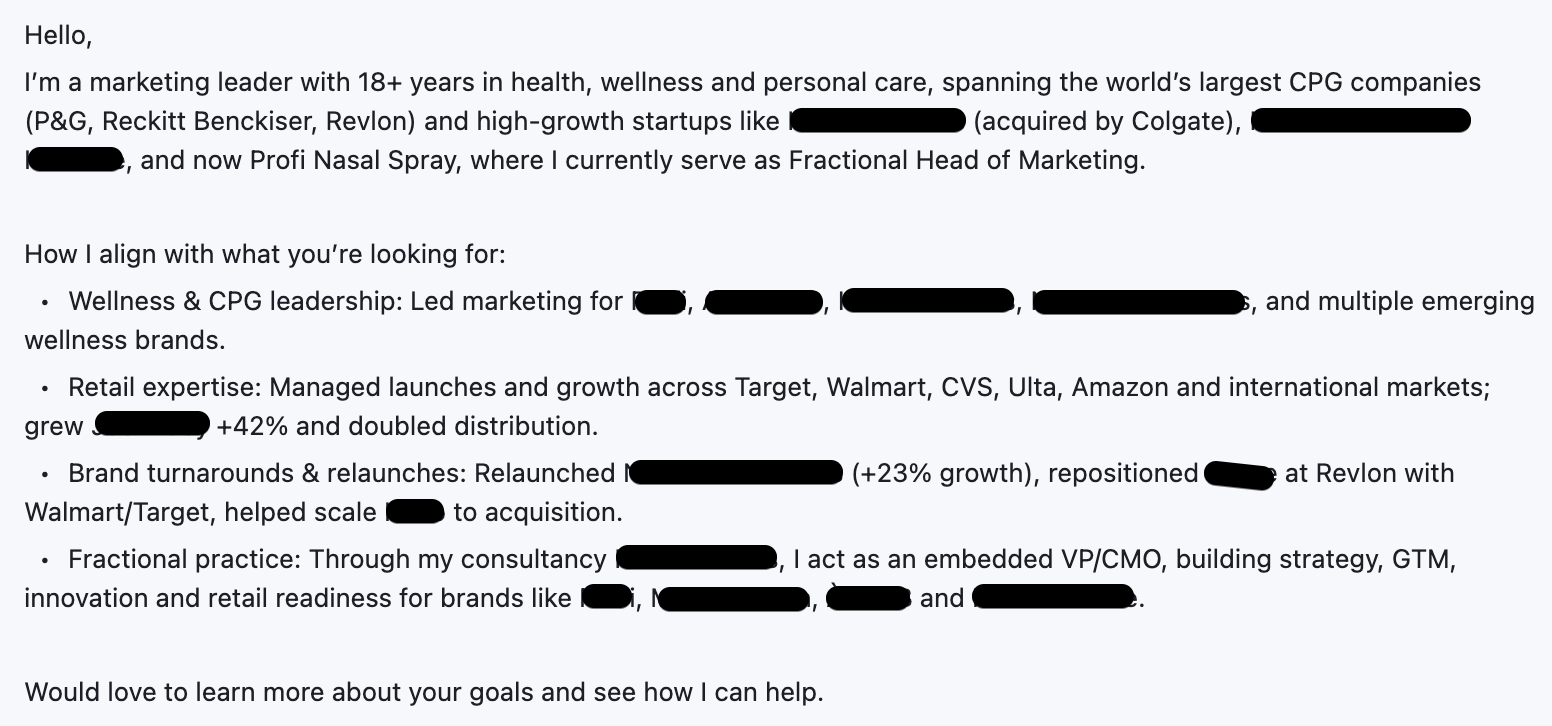
Notice how Tania started with a brief background on her career, and then quickly dove directly into the specific points the client cares about (from the job description), and showed how her experience matches directly with the client’s needs.
Tania was one of 3 candidates that the client chose to take an introduction to.
Tip: If you’re finding yourself really struggling to write an intro note that tells the client about your relevant experience, this is perhaps a sign that you’re not a great fit for the role after all.
Your Linkedin Profile
Share your Linkedin profile URL. Make sure the URL is the correct URL.
If you don’t have a Linkedin profile, it’s exceptionally difficult to get an introduction. We get it, Linkedin can suck, but the reality is the client has zero context on who you are, and a Linkedin profile introduces humanity and personality.
Keep in mind that Fractional Jobs and hirers are increasingly dealing with entirely fake profiles. A Linkedin profile helps reduce this risk.
Your Resume
This is strictly optional on Fractional Jobs. It can be a helpful supplement, especially when your Linkedin profile is sparse on information.
If you don’t have an updated one, it is not necessary to create one for an intro request.
It also does not need to be a “fractional-specific” resume.
A Loom (or other) Video
This is also optional on Fractional Jobs. But it can be really helpful!
A video brings so much life to your intro request, and gives you another touch point to help the client understand that you’d be a great match for them.
How important is a Loom video?
- If your background is not a good match given the job description, unfortunately a video is unlikely to change that
- If your background is an absolutely slam dunk 10/10 match, then a Loom video is also unlikely to change much, you’ll probably get an introduction regardless
- A Loom video is most helpful to push clients from “maybe” to “yes!”, or from “probably” to “hell yes!”
What Happens Behind the Scenes
After you submit your intro request, it first gets reviewed by the Fractional Jobs team. We check for:
- Completeness
- Accuracy
- Possible improvements
Fractional Jobs very much wants you to get an introduction, and we do a lot of work behind the scenes to present your profile in the best possible light to the client. If we notice an opportunity for improvement that we think will improve your chances, we’ll follow up with you to get more information.
We want our clients to have a good experience reviewing candidate intro requests, so we’ll also filter out intro requests that are fake, clearly written by ChatGPT, or otherwise wildly off base.
Once reviewed, we’ll then present your profile to the client, and wait for their feedback. We have a strict no-ghosting policy, so you’ll always receive updates from us about your intro request.
The Best Way to Respond to a Client Introduction Email from Fractional Jobs
Fractional Jobs works directly with companies that are looking to hire fractional leaders. When you “request an intro” for one of our Featured Jobs on our website, the client will review your profile and opt in to the intro if they think it might be a good fit.
When one of our clients opts in to an introduction to you, you’ll receive a direct email introduction to the client from Taylor.
Your goal is to make it as easy as possible for the client to have an intro call with you.
- Respond quickly (ideally within one business day)
- Follow the instructions in the email, sometimes the intro will include a scheduling link that the client provided
- If no scheduling link is provided, then send your own scheduling link or propose your upcoming availability
- Keep Taylor CCed on the email so he can provide proactive support in helping you close the client
Intro Response Example
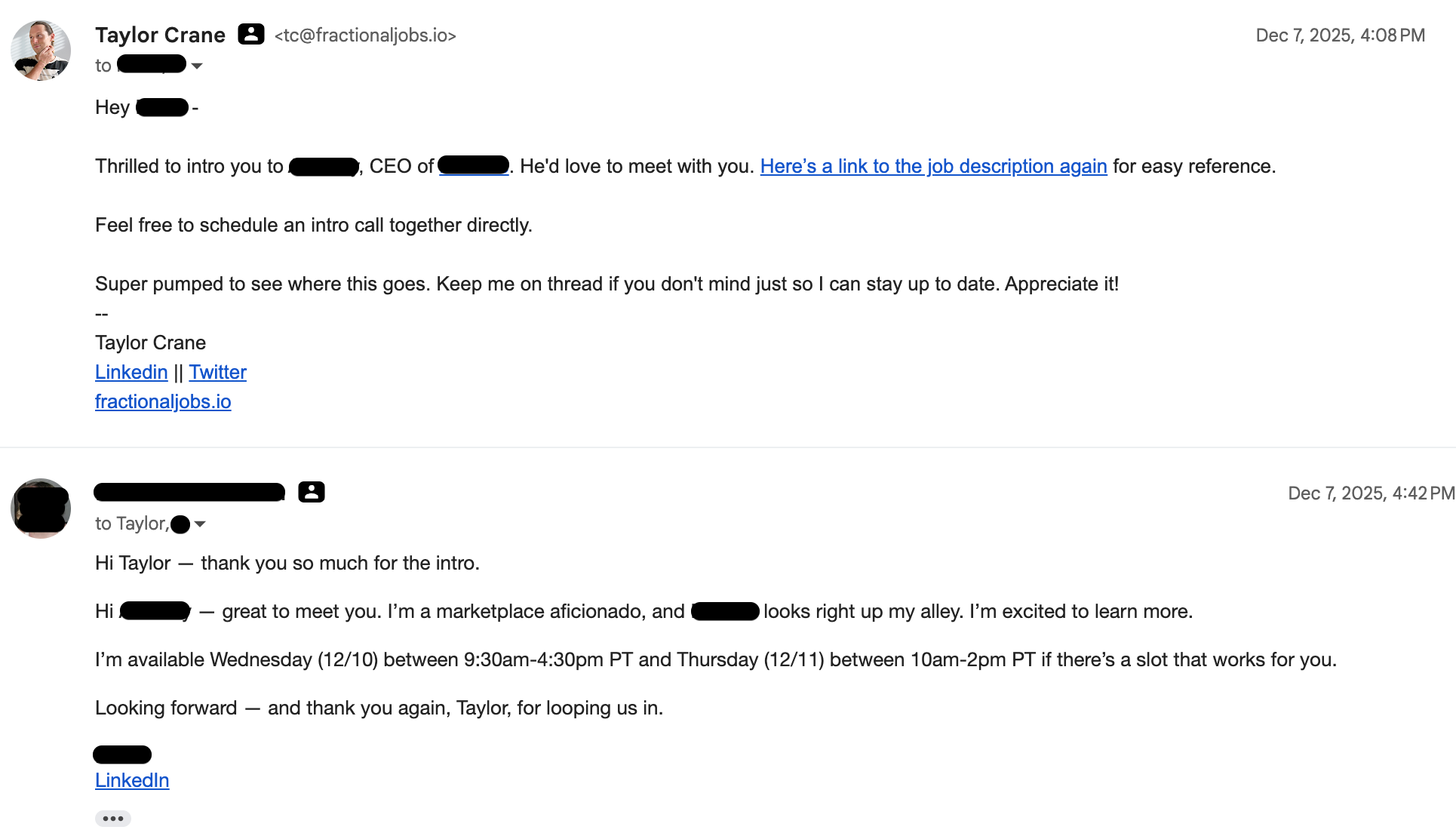
This is an example of a great response to a client introduction from Fractional Jobs. The candidate:
- Responded quickly
- Made it personal
- Offered up their availability for the client to choose
- Included time zones (don’t forget time zones!)
Easy enough, right?
What If The Client Does’t Reply?
Wait at least 48 hours.
Then, send a quick followup email to bump the conversation. If you got introduced, it means the client wants to talk to you. It’s likely they just missed the email or were temporarily distracted with other priorities.
If after followup you still haven’t heard back, then get in touch with Fractional Jobs ASAP and we will get involved to keep things moving.
—
If you’re ever unsure of how to proceed with a client introduction from Fractional Jobs, that’s what we’re here for. Just reach out to us and we’ll help guide you.
P.S. This article is also generally applicable to any client introduction you get, even if it’s not from Fractional Jobs.
What Types of Fractional Talent Can I Hire Through Fractional Jobs?
If you’re looking to hire fractional talent, Fractional Jobs can help if your needs meet the below criteria:
- Any function area and any industry
- Across the USA, Canada, The UK, Europe, Australia, and more
- Senior-level talent only, including C-suite execs, VPs and directors, and very senior individual contributors
- Compensation that ranges from $100 - $500+/hr (for US-based candidates)
We’re able to support such a large surface area of roles because we are the largest network of fractional talent in the world by far, currently sitting at 30,000 at time of writing.
Fractional Hiring by Function Area
Fractional roles in Marketing, Finance, Engineering, Sales, Operations, HR, Product, and Design are the obvious ones, and we have thousands of candidates in each of these categories.
But Fractional Jobs also has plenty of candidates in much more niche functional areas too. Examples include Fractional General Counsels, Fractional CISOs, Fractional Chief Medical Officers, Fractional Compliance Experts, and many more.
Fractional Hiring by Industry
We most often work with companies in industries like tech (and every niche within tech you can think of), eCommerce/CPG, healthcare, professional services, F&B/retail, and nonprofits.
And we support much more niche industries too. Some examples include: automotive, manufacturing, imports/exports, climate, financial services, … and so many more.
Fractional Hiring by Geography
The Fractional Jobs network is about 85% US/Canada-based. And we have fractional talent in the UK/Europe, and Australia too.
We work with plenty of US-based companies, as well as companies looking to expand into the USA with the help of fractional talent.
And we’ve also successfully supported countless companies’ fractional hiring needs across the UK, Germany, Egypt, India, Australia, Mexico, and more.
What Fractional Jobs Can’t Help With
We’re not a good fit if you’re looking for junior freelancers, or short project-based work.
We’re also not the right solution if your budget to compensate your hire falls below $100 / hr.
For this, we recommend places like Upwork, Toptal, or Fiverr.
How Can I Join the Fractional Jobs Talent Network? And is it Free?
If you’re looking for fractional work, joining the Fractional Jobs network is dead simple. Just head to the Fractional Jobs home page and add your email address. That’s it!
There is no lengthy signup process, you don’t have to create a profile for the 100th time, and you don’t need to be “approved”. Anyone can join.
Once you’re in, you’ll start receiving our weekly job alert emails every Monday, with all the new fractional jobs we’re launching. When you see an opportunity you think you’re a good fit for, you’ll follow the listed instructions to be considered for the role. This is when you’ll provide more information about yourself, your background, and your skillset.
We curate two different kinds of fractional jobs, which you can learn more about here.
And yes, Fractional Jobs is completely free to use if you’re looking for fractional work. If you’re hired by a company we’re working with, we do not take a % of your fees. Even better, you actually contract directly with the client, not through us.
Fractional Jobs charges companies a small, one-time referral fee (varies per role) if they hire a candidate from the Fractional Jobs network.
What is Fractional Jobs? (The site you’re reading this on!)
The company’s mission is to accelerate the fractional work movement. Today, we do that in two ways: 1) through our talent marketplace, which helps match fractional leaders with new client opportunities, and 2) through our educational resources, which helps both talent and companies learn about how fractional work works in practice.
For Talent
If you do fractional work, or are looking to break into fractional work, you’re in the right place. Fractional Jobs launches new fractional opportunities every week. If one is a good fit, it might become your next client.
To get started:
- Head to our website and add your email address
- Pay close attention to our weekly newsletter (sent on Mondays) with all our new jobs
- When you see one you think you’re a good fit for, follow the instructions on the job description
You should also learn more about the two different kinds of job opportunities on our site.
Then, to learn more about how to do fractional work successfully, start with The Complete Guide to Fractional Work.
For Companies
If you’re looking to hire fractional talent, you’re also in the right place. Fractional Jobs is the largest network of fractional talent in the word (30,000 at time of writing).
We help early-stage startups, SMBs, nonprofits, and more hire fractional executives and other fractional talent across 10+ different function areas.
We’ll introduce you to the best few candidates for your need, and if you like any you can hire them directly.
You can learn more about how our matching service works here. And if you’re ready to get started, book a call now with Fractional Jobs’ founder Taylor Crane.
What Makes Us Different
Unlike virtually any other talent marketplace, we take 0% commission. The fractional talent and the company contract together directly, without a middleman. Learn more about how we make money here.
On top of that, we publish some pretty great content (yes we’re biased), about doing fractional work, and it’s all free. Our mission is to accelerate the fractional movement, and this is part of how we’re doing it.
Founding Story
Fractional Jobs was started by Taylor Crane, and launched in February, 2024.
Taylor started doing Fractional work early in 2023, as a Fractional Head of Product, after selling/shutting down his previous company.
His plan was to start his next company while doing fractional work, and that company became Fractional Jobs. The inspiration for the company, as you can imagine, came from him doing fractional work. Taylor created the marketplace that he wish existed for himself.
You can follow Taylor on Linkedin if you want regular updates on how the business is going.
How to End a Fractional Client Engagement Gracefully
Like all things, every fractional engagement will eventually come to an end. Some fractional engagements end as planned, and others need to end because it’s not working out.
Regardless, you should do it gracefully. Here’s how.
Check Your Contract
Does your contract have a specific end date? Or, is it a month-to-month contract? Especially if you followed our contract best practices, your contract should include a clause about termination.
Often, a termination clause will say that either party can provide X days’ notice to the other party in the event the engagement needs to end. X is usually 15 or 30 days.
What to Do
At an absolute minimum, you must follow the termination clause in the contract.
But giving advance notice beyond what the contract requires is generally the respectful thing to do.
The basic steps are:
- Have the conversation in person. Don’t be like the person that breaks up with their significant other over text message.
- Provide the necessary “written notice”. Most contracts technically require this. This can take the form of a simple email after the in-person conversation is had just so that it’s in writing as well.
- Propose a transition plan. The transition plan is case-dependent, but may involve transitioning responsibilities to other parties, finishing final deliverables, and in the best cases actually hiring your replacement.
If you’re transitioning off a client and need to find them a new fractional replacement, Fractional Jobs can help.
What NOT to Do
- Do not randomly email your client that you’re ending the engagement
- Do not end the engagement in violation of your contract
- Do not become unengaged before the engagement ends. This should not be treated like quitting a full-time job
Where Can I Find the Best Fractional Talent for My Company?
To find the right fractional talent for your business, there are two rules to follow.
Rule #1: go to where the fractional talent already is.
Rule #2: cast a wide net, so that you maximize your chances of finding a perfect fit.
If you follow these rules, you’ll be set up to have conversations with the small subset of fractional leaders that are actually great fits for your need.
Rule #1: Go to Where the Fractional Talent Already Is
When you’re looking to hire a fractional exec or other fractional talent, you want to talk to folks actually doing fractional work. Therefore, you want to get your need in front of an audience of fractional talent, preferably a large one.
Folks that are explicitly doing fractional work already know how to manage their client relationships well, they know how to deliver outcomes in a time efficient way, and they won’t leave you the second they find a full-time job.
By going to where the fractional talent is, you’ll hire someone that actually knows how to do fractional work successfully.
Rule #2: Cast a Wide Net to Find the Perfect Fractional Match
Remember that the point of fractional hiring is to find someone that’s “been there, done that”, a proven operator in your industry, and with the exact skillset to solve the problems your business is currently facing. This is likely a very specific type of person, and they are not a dime a dozen.
There’s only one way to ensure you’re talking to the best possible matches for your need, and it’s to cast as wide a net as possible.
This is the whole point of Fractional Jobs, which has a network of 30,000+ fractional execs and other fractional talent. It’s a great place to start.
The wider the net, the more likely it is you’ll find the few candidates who can actually move the needle for your business on a part-time basis.
The Best Way to Hire Fractional Talent
It’s not easy to cast a wide net though, because the more candidates in your top-of-funnel the more work you have to do filtering through everybody. And there will be lots and lots of noise.
The best way to hire fractional talent is to get help from Fractional Jobs. It’s the largest audience of fractional leaders in the world, and we'’ll do all the candidate filtering for you, presenting you with the best options. Then, you can hire them directly.
Other potential ways to hire fractional talent include leveraging your network, posting on job boards, or using a headhunting firm.
Common Mistakes
However you decide to approach hiring, avoid these common mistakes:
- Don’t hire the first person you’re introduced to. Take the opportunity to talk to several candidates and compare options. You’ll learn a lot this way, and increase your chances of a successful relationship.
- Don’t use Linkedin Jobs, or other hiring platforms geared towards full-time work. Successful fractional leaders are not looking for full-time jobs, and if you do this you’ll be left with the candidates that are only settling for a part-time gig while they continue their full-time job search.
- Avoid the agencies if you can. They take a hefty 20 - 40% commission, which means much of your money is going to their overhead, and NOT to your fractional. The best fractionals work directly with their clients because they don’t need agencies to be a middleman.
Once you have a pipeline of potential candidates, you may want to learn about How to Interview Fractional Talent.
Can I Hire Someone for Fractional Work That Isn’t an Executive?
Companies commonly hire Fractional Marketing Directors, Fractional Engineering Managers, Fractional Heads of Sales, Fractional Product Managers, Fractional Operations Directors, Fractional HR Leads, Fractional Creative Directors, and many more.
All of these roles are fractional roles, performed by experts, and where a true c-suite executive is not the correct fit.
Seniority Levels of Fractional Talent
- 30% of fractional talent are true c-suite executives
- 50% of fractional talent are Director-level, VP-level, Heads of (but not c-suite)
(This data is from Fractional Jobs - the largest network of fractional talent in the U.S.)
The Differences Between a Fractional Executive and Other Fractional Talent
Every fractional leader, regardless of whether they’re a c-suite executive, has the following in common:
- Significant experience in their function area (usually 8+ years)
- Can set the strategy on their own
- Able to work independently with very little oversight or ramp time
- Comfortable owning outcomes, not just tasks or deliverables
Sometimes, companies misunderstand a fractional executive (or other fractional talent) to not be capable of doing hands-on execution work. This is not true. Some fractional leaders (whether they consider themselves an exec or not) prefer to stick to strategy and manage others to help execute. And many fractional executives are perfectly capable of, and even prefer, rolling up their sleeves and getting hands-on.
Even though fractional executives can be hands-on, there are still good reasons to hire a fractional leader that isn’t an executive. Examples include:
- When you don’t just need some hands-on execution, but you need a LOT of it
- When there’s no team to manage
- When your budget doesn’t allow you to hire a true c-suite exec
In all these cases, it’s likely better to target a fractional leader that’s a bit more junior than a true exec.
To wrap it all up, if you’re looking to hire a senior-level operator part-time, then you’re looking for fractional. The right job title, and skillset, and seniority, can vary greatly based on your need. The right fit might be a fractional executive, or it might be a plethora of other types of fractional talent.
And whether you need a fractional executive, a fractional director, or a fractional senior individual contributor, Fractional Jobs can introduce you to the best candidates for your need. It’s the largest network of fractional executives and other fractional talent in the U.S.
The Types of Companies That Benefit Most From Hiring Fractional Talent
These types of companies (with the exception of those going through a transition), are all small companies, and this is not a coincidence. There are two primary reasons for hiring fractional talent, 1) when you don’t have the need for a full-time hire, or 2) when you don’t have the budget for a full-time hire. (Read more about why you should hire a fractional leader here).
These constraints tend to be felt most by small companies, therefore fractional hiring is mostly done by early-stage startups, small businesses, and nonprofits.
Fractional Jobs has worked with 100+ companies to help them hire fractional talent, and 100% of those companies fall into one of these four buckets.
Fractional Hiring for Early Stage Startups
Startups are a huge adopter of fractional hiring. They tend to be early adopters in general, including of trends like remote work.
Naturally, startups are constrained by budget. They might desperately want to hire a full-time CTO, but simply cannot afford it. A Fractional CTO becomes a very attractive option, because it allows the startup to get access to the experience they need, but without running out of money.
Startups often find themselves searching for product-market fit. While they iterate on their product, they likely still want to get in front of customers, but aren’t ready to slam the gas pedal to the maximum. A full-time CMO might just be overkill given the breadth of marketing work that needs to be done. Nonetheless, the right tailored strategy from a Fractional CMO is a hyper-efficient way to grow at a pace the product can support.
As startups grow, their fractional need will graduate to a full-time need. And they tend to grow fast, too, so a startup’s Fractional Head of People might spend 9 months working with the company before transitioning out and finding a full-time Head of People to replace themselves.
Fractional Hiring for Small Businesses
Small businesses, too, love to hire fractional executives. They tend to optimize for steady, predictable growth, and they try to run their business efficiently, with an eye towards profit.
SMBs tend to operate with tight margins and strong cost discipline. They are often willing to invest in senior help, but only if the time commitment and cost make sense given the value they get. Fractional roles give SMBs access to seasoned operators who can modernize outdated processes, introduce best practices, or mentor younger full-time staff, all without the long-term cost burden of a full-time executive.
Even beyond budget, many functions like Finance or HR just don’t require a full-time executive given the size of the company.
Small businesses often hire Fractional CFOs, Fractional Heads of HR, Fractional COOs, Fractional Heads of IT, and more for these reasons.
Fractional Hiring for Nonprofits
Nonprofits are generally budget-constrained. Every dollar matters and spend needs to be highly justified. While they tend to be slower to adopt new ways of working, the cost savings of hiring a fractional exec are so undeniable that it’s becoming an increasingly popular way for nonprofits to get access to the talent they need.
Nonprofits often hire Fractional Operations Leaders to run the day-to-day. They’ll hire Fractional CFOs to own the financials.
Especially small nonprofits often hire a Fractional Head of Development (an industry term for fundraising) that can help the nonprofit unlock huge new sources of funding, like large donors, government grants, or other types of partnerships.
Nonprofits often struggle to attract talent because their compensation packages are usually smaller than the private sector. But one benefit of hiring a fractional exec is that, since the fractional exec typically has multiple clients, taking on an engagement for a nonprofit they care about doesn’t impact their earning potential as much. They have clients from the private sector that make up for it.
Fractional Hiring for Companies in Transition
Fractional hiring can also be helpful for companies going through a transition, regardless of their company size.
The most common types of transitions where fractional hiring could make sense are:
- A suddenly departing full-time executive
- A company exploring a totally new business opportunity
- A company downsizing
A departing executive leaves an immediate leadership gap. Sure, sometimes another executive can fill the gap, or someone more junior on the team can step up. But not every company has this luxury. Instead, hiring a fractional exec, even for half-time, can be a major pressure release that helps the company stabilize quickly. The fractional exec might even help you hire the right full-time replacement.
Similar logic is true for a company downsizing, where there’s a need for stabilizing the team, and where budget and flexibility are especially important (given the likely reasons for the downsizing in the first place).
On a more positive note, companies that are exploring totally new opportunities increasingly look towards fractional leadership for help. A company might hire a Fractional Head of Product to lead a skunkworks project to build out a whole new type of product. Or they might hire a Fractional CMO to lead their expansion into the US market. If a company has a hunch that a partnerships strategy might prove fruitful, they might hire a Fractional Head of Partnerships to find out for sure.
In all of these examples, the company needs someone senior to “validate” a business opportunity, but they’re not ready to commit to a full-time leadership hire. Perhaps, once validated, they might be.
Renewals, Extensions, and Conversions to Full-Time Hires
What’s Typical
Fractional work can often be an intermediate step for a longer relationship. Some professionals actively seek a fractional-to-full-time path; others prefer staying fractional long term, but they’ll still help you recruit and vet a full‑time replacement when it’s time to transition. In both cases, the goal is very clear communication and ownership of outcomes, clean handoffs, and minimal disruption to the work at hand.
For fast-growth startups, fractional roles commonly last 6-12 months, while for SMBs they often last 1-2 years (or more).
Renewals and Extensions
Renewals and extensions are common but never guaranteed. You should treat them as an active decision:
- Signal early: If you want to renew or extend, raise it 1-2 months before the current term ends. Discuss capacity (hours/week), outcomes, and any rate adjustments.
- Add an option clause: If you know that this is a possibility, you can negotiate a contractual option to renew within a limited period (e.g., 30-60 days) at a specific rate and for a specific number of hours. This protects continuity without forcing a long commitment.
- Re-confirm scope: Worst case scenario, if priorities shift in real time, just be up front and communicate early.
Generally, while renewals and extensions are normal, you should be advised that fractional hires ultimately have less long-term commitment relative to a full-time hire. If long-term optionality is important, make sure you’re discuss those intentions up front.
Converting to Full‑time
This is common as well. And even if a full-time role doesn’t make sense or work out, it’s just as likely for your fractional to help you find and vet their full time replacement. Some considerations:
- Have the conversation early: If your ideal outcome is converting the fractional into a full-time hire, it’s best to be explicit about that upfront. Many fractionals are not interested in full-time roles, and misalignment here can create friction later.
- Conversions do happen: According to Fractional Jobs data, roughly 20% of our referrals ultimately convert into full-time hires, making this a realistic but not guaranteed outcome.
Bottom line: Plan renewals/extensions early, capture options in the contract, and convert to full‑time if outcomes and fit justify it. Either way, your fractional hire can help ensure a smooth transition.
What Responsibilities and Scope Should I Give a Fractional Executive?
If you’re hiring a fractional exec, their scope will entirely depend on what your needs are. The scope can be as small and tightly defined, or it can be as large and open-ended.
What Fractional Execs Can Do
Fractional execs and other fractional talent generally come into your organization to own something by leveraging their past expertise.
Fractional execs can own a function area like Finance, Analytics, or Customer Success. This means they can establish the strategy for that function, they can manage or mentor existing team members, and they can hire and fire.
Other types of fractional talent can own a specific growth channel for your company. Or own a product area. Or own a sub-function like “People Operations”.
Fractional talent, even executives, can own execution too. It’s a common misconception that fractional leaders can only do advisory or consultative work. Absolutely untrue.
One of the most common requests that Fractional Jobs gets from our clients is to find a fractional exec that can do the necessary execution work. If you need help finding this kind of person, feel free to reach out.
What Fractional Execs Can’t Do
The limiting factor for what a fractional exec can do is primarily just their time commitment.
Fractional execs, at least the good ones, are exceptionally efficient and outcome-oriented. It is not uncommon to replace an underperforming CFO with an incredible Fractional CFO and see an increase in output.
But of course, fractional execs are not superhuman. Because of the time commitment you’re engaging them for, there are some practical limitations to their scope. If you’re engaging with a fractional exec for 5 hours per week, don’t expect them to have the same output as someone working 40 hours per week.
These limitations are resolved by prioritizing the highest impact work.
Communicating With Your Fractional Exec
Your fractional exec should be in your Slack, just like a full-time employee. If you expect them to be sending external emails, you should give them an email account too.
Generally, you should feel free to reach out to your fractional hire any time, though response times will vary. Different fractionals have different engagement styles, so you should be aligned with yours about how they work. Many are available throughout the week, as long as it stays in line with the agreed upon scope. Some fractionals, especially for roles like Engineering, might dedicate set days and times to different clients. This helps them protect the required deep work time they need.
Tip: If you’re considering adding your fractional hire to all the company meetings, ask yourself how important it is, given you have a limited amount of their time. You may find it’s not necessary, and this allows the fractional exec to stay focused on moving the needle for you.
Measuring Success of Your Fractional Exec
You should be tracking the success of your fractional hire based on the proposal and contract you agreed to.
Beyond that though, your Fractional CMO, or Fractional COO, etc. can be measured by customer growth achieved, or operational efficiencies created. In other words, by their outcomes. Just like you would measure a full-time hire.
If you feel like your fractional hire is not proving successful, consider the following:
- Are they missing expectations set in the proposal?
- Are you giving them the space and resources to be successful?
- Are they committing the time to your company that they said they would?
If you think your fractional exec is falling short, it may be time to revisit the relationship. There are so many great fractional execs out there that you can absolutely find a great match. Learn how Fractional Jobs can help.
How Much Does Fractional Talent Cost to Hire?
NOTE: If you want a very thorough guide that walks through exactly how much fractional talent costs to hire, including benchmarks with real numbers, then see our Playbook How Much Fractional Execs Actually Costs to Hire. This article below serves only as a high-level summary.
Why Fractional Hiring Is Cheaper
Fractional talent works for your company part-time, and their compensation is relative to their time commitment.
They’re also paid as an independent contractor, not an employee. As a result:
- You pay only for the time commitment you need
- No payroll taxes
- No benefits (healthcare, 401k, etc.)
- No paid time off
- No bonuses or equity
How Fractional Talent Is Compensated
Fractional talent is typically paid via:
- Monthly retainer (most common)
- Hourly rate
The monthly retainer or hourly rate is the total amount you owe your fractional hire, unlike full-time hires that earn a base salary + payroll tax, benefits, etc.
Typical Compensation Ranges
Let’s break down how much fractional executives actually cost to hire. To do this, we’ll look at data from Fractional Jobs (and the 100+ companies we’ve helped hire fractional talent so far).
The basic variables that determine compensation are time commitment, seniority, and expertise. The below data also assumes U.S. based hiring.
Example Hourly Rates:
- Fractional CFO: $200 - $400 / hr
- Fractional CTO: $200 - $300 / hr
- Fractional CMO: $200 - $250 / hr
- Fractional Head of HR: $175 - $225 / hour
- Fractional Head of Sales: $200 - $300 / hour
Premiums and discounts can be applied in some cases too. Former founders, and folks from blue chip companies (e.g. Stripe) may see a premium, for example.
If you want a much more robust list of compensation amounts for fractional execs and other fractional talent, broken out by seniority, function area, and more, check out our full Playbook here.
Calculate the Monthly Retainer
Once you have the rough hourly rate, calculating the monthly retainer as follows:
hourly rate * hours per week * 4.34 (weeks in a month).
So a Fractional CMO at $200 / hr for a roughly 10 hour per week time commitment would be paid a monthly retainer of $8K - $9K.
Bottom Line
Fractional hiring delivers senior output without full-time overhead. For many growing companies, the cost savings and flexibility make it a no-brainer.
If you want to hire fractional talent, and these rates sound good to you, then Fractional Jobs (the site you’re reading this on!) can help. We’ll introduce you to a handful of the best candidates for your need. Learn more here.
The best part?
You pay them directly. We’re not a middleman. So there’s no markup on their rates.
How to Hire a Fractional Executive and Other Fractional Talent
If this sounds similar to making a full-time hire, you’d be right! This article will focus on the key differences and nuances of fractional hiring compared to typical full-time hiring. You’ll walk away with a good baseline for exactly how to hire a fractional executive.
Define Your Fractional Need
There are four variables to consider when defining your need:
- Function area - Engineering, Marketing, Sales, Data, etc. The list goes on!
- Seniority - you can hire someone much more senior than you’d otherwise be able to afford. The sky’s the limit.
- Background/skillset - what type of expert do you need? No matter how niche, there’s probably someone out there for you.
- Rough Time Commitment - typically 2 - 20 hours per week. And, it can change anytime.
For a more thorough analysis of each of these variables, check out our in-depth Playbook on “How to Hire a Fractional Leader”.
Building Your Fractional Top-of-Funnel
You might have that perfect candidate in your mind, but your ability to hire them is only as good as your top-of-funnel.
The trick to finding the right candidates is to go to where the fractionals already are.
Fractionals are not browsing LinkedIn Jobs, or Wellfound, or Indeed, nor are they working with recruiting agencies. This is where people go for full-time jobs, but fractional leaders are not looking for full-time jobs.
You might think that freelance marketplaces like Upwork or Toptal are good bets. But fractionals adopted the word “fractional” to differentiate it from freelance work. Freelance marketplaces are the last place you’d find a fractional leader.
To build your top of funnel, go to where the fractionals are. Fractional Jobs is the largest network of fractional execs and other fractional talent. We work with companies to help them hire fractional talent across 10+ function areas. We target the exact right candidates for you, and then connect you with the best options. If you like any, you can hire them directly (not through us).
The Fractional Interview Process
If you have some candidates in the pipeline, how do you vet them? It’s a well-known fact that all interview processes are imperfect, and the best way to know if a candidate is a good fit for your company is if they simply start working for you.
Good news - in the fractional world, you can kick off a work relationship super quickly, and therefore find out quickly if there’s a long-term fit to be had.
Why can you start so quickly? Two reasons. 1) The risks of making a bad hire are much lower, because it’s a 1099 contract, you can generally part ways quickly and easily. 2) You don’t need to recruit the fractional hire away from another full-time job.
Check out our detailed rundown of How to Interview Fractional Talent here.
Signing a Contract
You’ll be signing a 1099 Independent Contractor agreement with your fractional hire. This is a standard document, but there are a couple of aspects that you’ll want to make sure are appropriately ironed out in the contract.
We cover the basics of what should go into a fractional contract here.
—
And for a more thorough walkthrough of exactly how to hire fractional leaders, including the different types of fractional engagements, more interviewing best practices, compensation expectations, and other FAQs, see our Playbook “How to Hire a Fractional Leader”.
If you’re a company that thinks fractional hiring might be right for your business, see how Fractional Jobs can help.
What Fractional Contracts Typically Look Like
NOTE: If you want a very thorough guide that walks through exactly how to create a fractional work contract, then see our Playbook How to Create a Contract for a Fractional Work Engagement. This article below serves only as a high-level summary.
A standard IC Agreement is a solid starting point, but fractional work has a few nuances you’ll want to address explicitly:
- Contract length
- Compensation & payment terms
- Scope of work
- Time commitment
- Cancellation
- Mutual NDA
If you don’t have an IC Agreement Template, we recommend this one from Common Paper.
Length of a Fractional Contract
Fractional engagements are usually ongoing, so contracts are commonly structured one of two ways:
- Month-to-month: Automatically renews unless canceled
- 3-month term: Requires renewal at the end of the term
Both are common. When in doubt, Fractional Jobs recommends a month-to-month contract for its extra flexibility. As trust builds, longer terms like 6 or 12 months become more typical.
Compensation & Payment Terms
There are two common ways to compensate fractional talent, a monthly retainer or an hourly rate, which you can read about in detail here. This should be clearly stated on the contract.
Some fractionals require payment upfront (common with agencies too). Others invoice after work begins, with prompt payment expected.
Avoid Net 30+ payment terms (meaning the contractor gets paid 30 days after sending the invoice) at all costs. This creates unfair cash flow problems for fractional workers.
Either agree for the fractional worker to be paid up front before work begins, OR agree to prompt payment on receipt of invoice (e.g. Net 7).
Scope of Work
Some contracts spell out detailed deliverables; others keep scope high-level. One common practice is to actually attach the Proposal (if it includes a Scope of Work), in an Appendix. For more details on how to create a proposal, see here.
Choose the level of detail that both parties are comfortable with.
Time Commitment
Because fractional work is part-time, contracts usually include an expected time commitment tied to compensation, such as:
- $10,000/month for up to ~10 hours/week
- $200/hour for 5 hours/week
This sets expectations and helps prevent misalignment. The hours are a guide, some fluctuation is normal as trust and rhythm develop.
Cancellation Clauses
A cancellation clause allows either party to end the contract if needed. They’re exceptionally common in fractional work contracts. For month-to-month contracts, 15- or 30-day notice periods are most common.
Unless there is good reason, cancellation clauses should always be the same for both parties.
Mutual NDA
A mutual NDA ensures both sides protect confidential information, use it only for the engagement, and follow reasonable security practices. Public or independently known information is excluded, and trade secrets typically remain protected indefinitely.
This was a high-level breakdown, but if you want a more detailed guide, see our Playbook here.
Do Fractional Execs Typically Have Multiple Clients? Or Just One?
Fractional Jobs Audience Data
Fractional Jobs is the largest network of fractional talent in the world, with a database of about 40,000 fractional executives and other fractional talent (as of Feb 2026). In this group, about 25% work with one client. Around 60% are working with two or more clients. And roughly 15% are still searching for their first client.
When One Client Make Sense
Some folks choose to only have one fractional job at a time. They usually fit one of the following categories:
- They’re down-shifting in their career to spend more time with family, traveling, on a hobby, etc.
- They’re starting a company themselves, and are using fractional work to make income while they bootstrap
- They’re brand new to fractional work, are just getting started, and have only landed one client so far
- They have a full-time job, and are “moonlighting” with a fractional client
Having one client, however, is the minority.
When Multiple Clients Makes Sense
Most often, fractional leaders have multiple clients, usually 2 - 4. This allows them to make enough money to replace, or even exceed, the compensation of their previous full-time job. It’s also where a large part of the appeal of fractional work comes from - the opportunity to work with multiple small businesses at a time, leveraging past expertise to help them grow.
How Many Clients Can A Fractional Have?
There’s no hard limit on how many clients a fractional can take on. What’s typical will depend on two factors: the type of fractional work they do, and how much work they want to be doing overall.
Different functional areas require different levels of involvement per client. Fractional CFOs, for example, tend to be needed by their clients around 5 - 10 hrs per week. As such, it’s not uncommon for a Fractional CFO to have 4, 5, even 6+ clients. On the other hand, Fractional CTOs tend to be much more involved engagements, the work is just very different from Finance. As such, Fractional CTOs tend to have 2, maybe 3 clients at a time.
And then of course, if a fractional leader wants to push themselves to work more, picking up more clients than what is typical, nobody is stopping them. And the inverse is also true, if a fractional wants to work less than others, then more power to them as well.
What Does a Fractional Job Typically Look Like?
The work itself looks very similar to a full-time job, but because a fractional leader is a part-time independent contractor, there are four other key variables that help dictate what any given fractional job looks like.
These four variables are the length of the engagement, the scope of work, the compensation, and the contract terms.
Length of Engagement
Typically, a fractional job might last for a few months, to a year or more. The essence of fractional work is that it’s ongoing in nature, NOT project-based.
The length depends greatly on the company trajectory and what the needs are. A high-growth tech startup might need a Fractional CMO for 6 months before they outgrow them and need to hire a full-time CMO. A small business growing 10% per year might engage with a Fractional CFO for 3 years before graduating to a full-time CFO.
Scope of Work
We already know that a fractional job is part-time in nature. But exactly how much time is required depends greatly on the needs of the business.
A small chain of coffee shops might need a Fractional Head of HR for high-level guidance on policies, compliance, and onboarding/offboarding best practices. This might require just 5 hours a week of commitment.
However, a B2B SaaS startup might have an engineering team of 5, based offshore, that are in desperate need of architecture guidance, code reviews, and mentorship. For this client, a Fractional CTO might need to dedicate 20 hours per week.
Fractional work is designed to flex around a company’s needs and budget - often 2, 5, 10, or 20 hours per week, and covering everything from strategic leadership to hands-on execution. It may even include management of others, including full-time employees.
Compensation
Fractionals are typically compensated via an hourly rate or a monthly retainer. A monthly retainer tends to be preferred, because it creates a mutual commitment that the relationship is ongoing.
For more details about how fractionals are compensated, including compensation benchmarks, see How Much Fractional Talent Typically Costs to Hire.
Contract Terms
When starting a fractional engagement, the fractional and the company will sign an Independent Contractor agreement. This agreement is a standard 1099 contract, and for fractional work it usually covers the following:
- Contract length / term
- Compensation
- Cancellation clauses
- Scope of work
For more details about contract best practices for fractional work, see our article here.
Other Differences with Fractional Work
A single fractional job in many ways looks like a full-time job, but most fractional leaders have multiple clients. And because of this, fractional work actually feels VERY different compared to full-time work. Fractionals have to find their own clients, they have to juggle multiple clients, they have to manage their LLC, practice good client relationship management, and so much more.
We cover these topics elsewhere in The Complete Guide to Fractional Work.
What a Fractional Job IS NOT
Fractional work is not a fixed-scope project. It’s not purely consultative. It’s not an advisory agreement. It’s ongoing, embedded work, just done fractionally.
To see what fractional jobs are available now, check out all the live jobs on Fractional Jobs.
What Are the Most Common, and Least Common, Fractional Roles?
Some of the roles rising in popularity include the Fractional Head of Sales, Fractional Head of People / CHRO, and the Fractional COO.
What the Data Shows
Fractional Jobs recently analyzed 647 fractional job postings, and the breakdown is below.
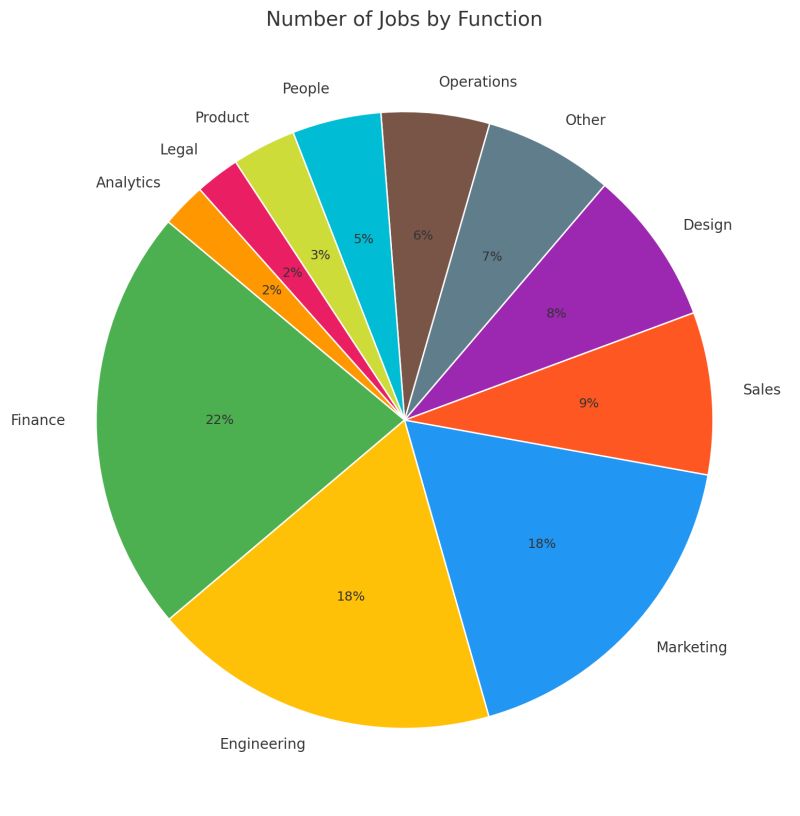
Most Popular:
- Finance (22%)
- Engineering (18%)
- Marketing (18%)
Rising in popularity:
- Sales (9%)
- Operations (8%)
- People / HR (5%)
Least Common:
- Analytics (3%)
- Product (3%)
- Legal (2%)
If you’re doing fractional work, or looking to hire fractional, in one of the less common areas, DO NOT PANIC. There are countless successful Fractional Chief Data Officers, Fractional General Counsels, and Fractional Heads of Product. In fact, Fractional Jobs’ founder Taylor Crane was a Fractional Head of Product for a year before starting Fractional Jobs.
Why Some Roles Are More Popular Than Others
What makes some fractional roles more popular than others has to do with how companies think about solving needs within their org.
If a company has a burning Finance need, their first instinct is almost certainly to bring in an expert vs. trying to do it themselves.
Conversely, if a company has messy operations, the first instinct is likely to be to try to improve it with existing resources instead of hiring someone new.
Fractional Jobs calls this Level 1 Fractional Hiring (e.g. Fractional CFOs), vs. Level 2 Fractional Hiring (e.g. Fractional COOs). There’s even a Level 3.
As fractional work gains adoption, companies will naturally graduate from Level 1 to Level 2, to Level 3, etc., paving the way for more and more fractional opportunities.
To read more about the different levels, check out “Why Don’t I See Any Fractional Jobs in My Function Area?”
The Difference Between Fractional Work, Freelancing, Consulting, and Agencies
Fractional Execs
- What they are: Embedded, part-time senior operators (e.g., CMO, CFO, CTO, COO, Heads of Function) with 10–20+ years of experience, operating like full-time leaders, just part-time.
- Example responsibilities:
- A Fractional Head of Sales might step in to lead your sales motion. Set up your sales stack (cold email campaigns, inbound prospect workflows, CRM, etc.), coach your junior sales staff, write playbooks about objection handling, and set up measurement and reporting.
- A Fractional CFO might own your budget, forecasting, and create scenario models so the business can better see into the future. They can handle board prep, fundraising diligence, or even M&A activity as well.
- Cost structure: Monthly retainer (e.g., $Xk/month for Y hours/week)
- Contract structure: Independent contractor agreements, commonly month-to-month or short fixed terms (3–6 months), designed for ongoing work.
Consultants
- What they are: External senior advisors or consulting firms that analyze problems and recommend solutions but typically do not own execution or embed themselves within your organization.
- Example responsibilities:
- Conduct a go-to-market audit and deliver a strategic recommendation deck
- Perform financial or operational diligence ahead of a fundraise or acquisition
- Cost structure: Project-based fees or hourly rates; high cost per hour, limited to defined scopes. Typically much more expensive than fractional talent, but useful for highly scoped deliverables.
- Contract structure: Fixed-duration engagements tied to specific deliverables (reports, models, playbooks).
Agencies
- What they are: Execution partners staffed primarily by junior to mid-level specialists, overseen by senior account managers.
- Example responsibilities:
- Design and launch a new marketing website in Framer
- Run and optimize paid search or paid social campaigns against a defined brief
- Cost structure: Monthly retainers with built-in overhead and margins; typically more expensive than hiring execution talent directly
- Contract structure: Retainers with SLAs and predefined deliverables; longer minimum commitments are common.
Freelancers
- What they are: Independent individual contributors, typically junior to mid-level specialists, working on discrete tasks or short-term needs.
- Example responsibilities:
- Write a set of landing page copy based on provided messaging
- Build a one-off dashboard or script to automate a reporting task
- Cost structure: Hourly or per-project pricing; lowest overhead option.
- Contract structure: Short-term or project-based agreements with clearly defined outputs.
Am I a Good Fit for Fractional Work?
Before making the jump, it helps to evaluate fit from a few different angles.
Signs You Might Be a Strong Fit
Fractional roles are designed for people who can create impact quickly without much hand holding. This likely means you’re an expert in something, and can leverage that expertise to help certain types of companies in big ways.
You are more likely to be a strong fit if you:
- Have executive, leadership, or other senior-level experience in your function
- Can point to clear outcomes you’ve owned, and value you’ve created for other companies in your prior full-time work
- Can be effective despite ambiguity, and without the resources of large corporations
But that alone isn’t quite enough, because to be successful you also have to find clients.
You Have to Do Sales Work
You need to find your own clients, and convince them to work with you. This is generally considered the hardest part of fractional work.
Fractional execs often spend 5 to 10 hrs a month doing sales work for themselves, and it can be much more than that in the early days and in low periods.
Fractional Jobs (the site you’re reading this on!) has dozens of opportunities available on our job board at any time, but you’ll still need to find your own clients too. For a breakdown on how to do this, see How Do I Get My First Fractional Clients?.
Lifestyle Fit and Personal Preferences
Doing fractional work is, in part, a lifestyle choice.
Many fractionals are drawn to it because they value flexibility, variety, and being measured on real business outcomes. Others appreciate the ability to design their schedule around family, travel, or personal interests while still staying professionally engaged.
The flexibility works both ways, and fractional work can therefore be less predictable than traditional employment. Income can vary, workloads shift, and you are responsible for managing your own time efficiently. If stability and routine are top priorities, fractional work might quickly feel uncomfortable.
Your Market Fit Matters Too
You might have the interest in doing fractional work, and even a large network too to help getting potential clients, but there also needs to be enough demand for your specific skillset and experience.
With fractional work, you’re selling a product (yourself), and there needs to be enough potential buyers for you to build a business.
To better understand your fit with the market, check out How Do I Position Myself to Attract Fractional Opportunities, and Why Aren’t There Any Fractional Roles for My Function Area?
You Are a Business Owner Now
Choosing fractional work means choosing self employment. You are essentially running a business of one.
Being a business owner comes with upside, including control over your client mix, schedule and income potential. On the other hand, it also comes with responsibility, including managing your own taxes, contracts, benefits, lead generation, and cash flow.
The Fractional Toolkit offers several recommended services to help take some of this off your plate, including health insurance and taxes.
In Summary
Fractional work is a strong fit for people who have experience, adaptability, and a desire for ownership. These individuals enjoy the autonomy and variety that comes with managing different client work. And the fractionals who find the most success possess a deliberate skillset that align with real business pain points.
If you want a more in-depth breakdown of what it takes to do fractional work, check out our Playbook “Am I A Good Fit For Fractional Work?”
How to Interview Fractional Talent
When you are hiring a fractional exec, or other fractional talent, the interview steps should ideally take the following arc:
- The intro call
- The evaluation
- The proposal
- The decision
Fractional Jobs recommends conducting at least 5 intro calls to get a sense for the types of candidates out there. Then, you’ll likely want to receive at least 2 proposals so you can compare approaches, before making your decision.
The Intro Call
The intro call is the start of the fractional hiring process, and it’s typically between the hirer (usually the founder or business owner), and the fractional leader.
Typical length: 30 minutes
Purpose:
- The company should describe the problems it’s facing, at a high-level
- The fractional candidate should describe how their background, skillset, and prior experiences make them a potential fit to solve those exact problems.
Remember that when you’re hiring fractional, you’re doing so because you have a problem that needs to be solved. So describe your problem, and then let the fractional candidate tell you why they can help you solve it.
Tip: Talk about budget and compensation on the intro call. Make sure you and the fractional candidate are broadly aligned. Unlike the full-time world where it’s common to “make an offer” at the final stage of the process, in the fractional world candidates often have their own set rates. Ask them! Of course, everything is still negotiable.
The Evaluation
After the intro calls, you’ll likely want to spend a bit more time with some of the candidates diving into the details of your problem, and evaluating exactly how each fractional candidate would approach solving it for you.
This usually takes the form of a deep dive discussion. It may also involve looping in other team members to get their feedback and buy-in.
Typical length: 1 hour (per meeting)
Purpose:
- Walk the candidate through your business, and the core problems you need help with in more detail
- Ask the candidate to talk you through how they’ve solved these kinds of problems for other businesses just like yours
- Give the fractional candidate enough information for them to be able to put together a proposal with a scope of work for you
Tip: The evaluation phase is a good time to ask the candidate about how their fractional practice works. How do they balance multiple clients? Do they expect to be available throughout the week, or only on set days? How will you communicate (Slack or email?)
The Proposal
The proposal is the final stage, and this is quite different from full-time hiring. In the fractional world, it’s typical for candidates to put together a proposal for you that outlines 3 things:
- The rough scope of work
- Their cost (i.e. their compensation)
- The timeline of deliverables (if applicable)
A proposal can take the form of an email, a presentation, or any other kind of written document.
It’s your opportunity to align on what success looks like, and hold your fractional hire accountable to it. It also creates opportunity for further discussion. Perhaps there’s something you want to re-prioritize, or cut from scope, or learn more about.
Tip: If you’ve not received a proposal from a candidate, do not be afraid to ask for one. This is a huge benefit of hiring fractional compared to full-time work, so take advantage.
The Decision
Once you have a candidate you’re excited about and a proposal you’re aligned on, it’s time to move forward. Don’t be afraid to move quickly! Because fractional engagements are so flexible, the risks of making an incorrect decision are comparatively quite low.
Tip: Feel free to ask your intended hire for reference checks as well, either from full-time employers, or even better from recent fractional clients of theirs.
Using Fractional Jobs to Help
One nice benefit of using Fractional Jobs to find candidates is that you’ll work directly with Taylor Crane throughout the process, and he’ll guide you on interviewing and evaluation best practices along the way. Fractional Jobs will typically introduce you to ~5 candidates to start your process, and will continue to find more candidates for you until you find the perfect fit.
Fractional Talent for FinTech
Fractional talent can be incredibly effective for fintech teams, particularly those building regulated products without the headcount of a large bank or established financial institution. Fintech companies face unique challenges. Licensing requirements shift, fraud attempts scale with growth, and the cost of regulatory missteps can be existential. At the same time, investor expectations often push fintech operators to move quickly, enter new markets, and expand into additional financial products long before they have the in-house expertise to support them.
If you are not operating at the scale of a major bank, payments processor, or established lending platform, you may still need access to the depth of experience those companies rely on. Fractional hiring fits fintech unusually well, and we have seen countless early and growth stage teams use fractional experts to ensure speed, accuracy, and compliance coexist.
Here are a few scenarios where fractional talent is especially impactful for fintech companies:
- Standing Up Compliance and Licensing Infrastructure: **A fractional compliance or regulatory leader can set up required policies, support licensing applications, and create documentation that meets federal and state expectations. These leaders often have deep backgrounds in banking, payments, lending, or trust charters. They help companies stay ahead of audits without slowing product momentum.
- Strengthening Fraud Prevention and Risk Management: A fractional risk expert can build risk frameworks, tune fraud models, and establish escalation procedures. They can also help select and integrate third-party risk tools, evaluate transaction patterns, and reduce losses. This is especially valuable for companies experiencing rapid user growth or entering higher-risk financial products.
- Designing Revenue Models and Capital Strategy: **Fractional finance or capital markets leaders can model unit economics, analyze margin drivers, and help structure debt facilities or treasury strategies. They can advise on securitization, funding partners, or interchange optimization. Their experience helps founders avoid costly mistakes while scaling responsibly.
- Accelerating Product and Compliance Alignment: Fractional product leaders with fintech experience can guide teams through the nuanced intersection of product development and regulatory requirements. They help ensure new features meet both user expectations and compliance standards. This is particularly useful for teams building payments, lending, or embedded finance products that require precise controls.
Fintech Case Study
Tabs is a growth-stage fintech that just raised a Series B. When they wanted to explore a skunkworks-style new product, they asked Fractional Jobs to help them find an AI-native Fractional Product Lead to spearhead the efforts. Someone that can operate away from the core team, for 20 hours per week, and validate the project.
Fractional Jobs has also helped:
- Flash (B2C fintech) hire a Fractional Head of Product for 10 hours per week
- Midlyr (B2B fintech) hire a Fractional Chief Compliance Officer for 5 hours per week
- Hearth (vertical SaaS) hire a Fractional CFO for 20 hours per week
With similar results.
Get help hiring a fractional exec for your fintech, learn more here.
How Much Does it Cost to Hire Through Fractional Jobs?
Our pricing is designed to make us a no brainer. It’s affordable, simple, and incentives are aligned.
The Referral Fee
ONLY If a company signs a contract with a candidate, do we charge a $3,000 to $8,000 referral fee. The fee depends on criteria like the type of candidate needed, if there are geographic restrictions, and how many hours per week is needed from the talent. To learn more about which fee bucket your role falls into, get in touch.
If you’re thinking “damn, that’s cheap”. Don’t worry, there is no catch. Really, this is designed to be a no brainer. The companies we work with are regularly blown away by the quality, speed, and affordability, and we intend to keep it that way.
How Hiring Works
If a company hires a candidate from our network, they do so directly. Fractional Jobs is not a middleman. The company and the talent negotiate an agreement together and sign a contract together.
It's Free for Talent
Fractional Jobs is free for fractional talent to use. We take 0% of earnings.
Why Should I Hire a Fractional Executive?
When you hire a fractional executive, you get someone with a significant amount of experience in the problems you need solving. The arrangement is incredibly flexible, hours can be scaled up or scaled down quickly. And you save money compared to a full-time hire.
If you don’t have the need for or budget for a full-time hire, a fractional leader is an exceptional option. And if you do hire a fractional exec, you’ll unlock a range of benefits that come with fractional leaders. Fractional work is growing in popularity for very good reasons, after all.
The Expertise Benefit
When you hire a fractional leader, you’re getting someone that has been there, done that. They’re an expert in your industry, they’ve solved problems that you need solved, and they can come into your org to get it done for you quickly.
This cannot be understated - if you’re hiring fractional, you have the opportunity to find someone that has literally the exact industry and skillset you need today. This happens to be one of the things Fractional Jobs (the site you’re reading this on!) is best at. Finding needles in haystacks for your company.
Aside from industry/skillset expertise, fractionals also bring a level of pattern recognition that is hard to match. After working with many companies, they know what usually works, what usually fails, and which levers create the most impact for a business like yours. They can diagnose issues quickly, help you avoid common mistakes, and accelerate the work that matters most.
Oftentimes, these are folks that you’d never be able to hire full-time anyway. But you can get them fractionally, and pay them for exactly what they’re experts at.
The Flexibility Benefit
When you hire a fractional leader, you do so via an Independent Contractor Agreement. If you need more time from your fractional, you can scale them up. If you need less time, you can scale them down.
You can start a relationship super quickly to assess fit. No need to recruit this hire away from another full-time job.
The risks of a bad fit are low, too. If the relationship is not working for whatever reason, simply part ways.
Fractional leaders begin adding value very quickly. Because they have done this work many times before, they do not need a long onboarding period to understand your business. They can ramp up fast, diagnose what needs attention, and start moving important work forward almost immediately.
At Fractional Jobs, the companies we work with tend to make a hire within two weeks of getting introduced to candidates. Often times, the relationship continues for months or even years. Sometimes, the fit isn’t right, and so we simply find you a more fitting option.
The Cost Benefit
When you hire a fractional leader, it’s on a part-time basis. You’re getting the most impactful 5, 10, 20, etc. hours per week from that fractional. And you’re only paying for what you need.
An equivalently skilled full-time hire would cost you much more. If you hire a full-time executive for $200K / year, that’s just their base salary, not including payroll taxes, health benefits, vacation/sick days, bonuses, stock options, etc.
When you hire a fractional executive, you might pay them a monthly retainer of, e.g. $10,000 / month, and that’s all-in. No extra expenses. Not even their laptop!
Read more about how much it costs to hire a fractional leader here.
—
If you want to dive into more details about why you should hire a fractional exec, including examples, how to hire, and common objections from hirers, see our Playbook “How to Hire a Fractional Employee”.
If you’re a company that thinks fractional hiring might be right for your business, see how Fractional Jobs can help.
How to Position Yourself to Attract Fractional Work
Tell companies what you’re an expert at. Make it easy for them to connect the dots between what types of problems you can solve, and the problems their company is currently facing. Make them think “Wow, that’s exactly what I need!”
You can think about fractional hiring similar to buying a product: the buyer has a problem, and they’re shopping for products that might solve it. This article is about how to design your product label, a.k.a. your positioning.
How to Define Your Expertise
Unsurprisingly, you’re the only person capable of defining your expertise. You know your career, accomplishments, and skillset best.
What are you an expert at?
What have you spent your career focused on?
What kinds of problems have you solved for companies most frequently?
What do people come to you for advice on?
Common ways fractional leaders choose to define their expertise include by industry, by company stage, and by strategic specialty. We’ll explore these more in a bit.
But these are just some examples. You can also define your expertise by the outcomes you deliver, by business model, by regulatory environment, and more.
Niching Down
Niching down is very common advice in the fractional and consulting world. It essentially means to get even more specific with your positioning than you originally thought necessary.
Why?
Imagine you operate a restaurant, and your gorgeous wood tables constantly get dirty with food. You need a quick cleaning solution, so you go to the store. Do you reach for the “all-purpose cleaner”, or the “wood cleaner” solution? See the point?
Most new fractional leaders make a mistake by trying to appeal to any possible client that might encounter them. But clients turning to fractional hiring have very specific problems to solve. 9 out of 10 times they are going to choose the person positioned as an expert at those specific problems. Not the one who claims to solve all possible problems.
Bad Examples
- “I’m a Fractional CMO” - yes, you, and literally 10,000 others. Get more specific.
- “I’m a Fractional CMO, CRO, COO for healthcare companies” - Great that you’re focused on healthcare, but it’s highly unlikely that you’re an exceptional CRO if you’re also an exceptional COO.
- “I’m a Fractional CFO for startups, scaleups, SMBs, and enterprises” - you’ve included all the buzzwords. But the role of a Fractional CFO is very different depending on company size and stage, and anyone hiring one will know it.
All three of these examples are from fractional execs that are trying to appeal to too many clients at once, and therefore appeal to nobody strongly enough to stand out.
On the other hand, good examples of fractional positioning clearly define their exact expertise. They act like a product label that solves certain problems really well.
Here are three, real-world examples of folks in the Fractional Jobs network, screenshotted directly from Linkedin.
Good Example: Stage-specific Positioning

They are a Fractional Product Leader focused on early-stage tech companies specifically. If you’re an early-stage tech company that needs Product leadership help, this might resonate. This person, if they were struggling to attract clients, might even choose to niche down further by defining some types of Product work they’re best at, e.g. MVP scoping.
Good Example: Industry-specific Positioning

They’re a Fractional CMO focused on mental health and women’s health startups around the Series A - C range. Imagine if you’re a Series B mental health startup in need of marketing leadership. How are you NOT contacting this person!?
Notice how they’re not just for any health-tech company. They’re focused on mental health and women’s health.
Good Example: Strategy-specific Positioning

They’re a Fractional Marketing Director with specific Brand expertise, covering auditing, positioning, and messaging. Not pictured here, but elsewhere on their Linkedin profile it’s clear that they work exclusively within the F&B industry.
Bonus points for going for “Marketing Director” and not “CMO”, too. Not everyone needs a CMO.
Alternative Approaches
Some fractional leaders tend to lean more on the traditional consulting playbook, which advises to drop titles altogether and just describe what value you create.
Fractional Head of Sales —> “I help B2B SaaS founders transition out of a founder-led sales motion.”
Fractional CFO —> “I get your SMB ready for PE and M&A”
Test Your Positioning
As any Fractional CMO will tell you, your positioning should be tested, even informally.
Consider sending your positioning to:
- Close professional friends
- Mentors
- Past colleagues and bosses
- Your target ICP (i.e. the people who’d be hiring you)
The first three know your work best. They can give you feedback on how well it articulates your value. The fourth, your ICP, will give you the most important feedback - how well your positioning resonates with their needs.
This article is not a rulebook for fractional positioning. In fact, like any kind of marketing, sometimes breaking the rules is what gets you ahead.
Your goal is to find positioning that works, measured simply by # of clients acquired.
How to Get Your First Fractional Clients
NOTE: If you want a much more in-depth breakdown on how to find your first fractional clients, check out our Playbook here. This article serves as a short high-level guide.
84% of fractional leaders find their first client from their network, according to Fractional Jobs survey data. And even beyond the first client, virtually all fractional leaders get most of their clients through their network.
The best path to finding clients is making your network (1) aware you do fractional work, (2) reminded of it, and (3) understand what kind of companies are a good fit for your work.
Let’s look at how that works, in practice.
Step 1: Engage your Network Privately
Begin with 1:1 outreach to people who can vouch for you (former managers, teammates, mentors) and people who are well-connected. The goal is not “ask for a job.” The goal is to practice your pitch, get feedback that sharpens your positioning, and surface warm intros you would not get from a public post.
You might get your first client from this step alone. In this case, there’s no need to advance any further until you’re ready for more clients.
Step 2: Announce Publicly Once You’re Ready
When you have your positioning reasonably clear and you actually have capacity for new work, make a public LinkedIn announcement. Keep it simple and authentic. A single announcement rarely creates a flood of leads; but one qualified conversation is a win.
Even if you don’t get a client from announcing your work (most won’t), you’re still laying the foundations.
Step 3: Stay Top-of-Mind
After the announcement, your goal is to remind your network, consistently, about the kind of work you do. There’s many different ways to approach this, but most of them do involve posting content on Linkedin (or other channels).
You might share thought leadership content, or share case studies of your work, or be a teacher on your area of expertise. There are even common tactics to generate scarcity. We cover all this in more detail in our Playbook here.
Staying top-of-mind, however you choose to do it, is the key to sustained lead gen from your network. It’s what makes it possible for folks in your network to recommend you.
Step 4: Expand Beyond Your Network, e.g. Talent Marketplaces like Fractional Jobs
Once the above is in motion, it starts to make sense to expand your surface area through communities, events, channel partners, and more.
One great supplement is Fractional Jobs (the site you’re reading this on!). We launch new fractional roles every single week.
More Tactics: Client Referrals
As you work with more clients, the opportunity presents itself to get introductions from past clients to potential new clients. For this to work, you have to do great work. Duh! At the end of a successful relationship or after a big milestone, ask for a testimonial. And find ways to let your clients know that you’re always welcome to new introductions. Sometimes your clients just may not realize how valuable introductions are for fractional leaders, and subtle reminders may help.
More Tactics: Cold Outreach
Cold outreach is, for the most part, an advanced strategy. Especially at scale, it takes a significant amount of knowledge and effort to get right. However, if you have a REALLY dialed-in target client list, with a REALLY dialed-in value prop, it might just work.
Put together a list of your target clients and do manual outreach to the most likely decision maker, e.g. the CEO. Do this manually. Only try to automate this if you’re seeing traction (or you’re a cold outbound expert).
If It Still Isn’t Working
If you’ve run the network steps consistently and still have no traction, it usually means either your positioning needs work, or your current network is not large/activated enough to generate qualified leads yet.
In Summary
Getting your first fractional client will be very different from getting your 25th client. Your first client will almost certainly come from someone in your network hiring you or recommending you. Start with your network, and only move onto more advanced strategies once that’s already working.
If you want a more detailed rundown of everything that goes into using your network to find clients, check out our lead gen Playbook here.
What is Fractional Work?
Companies are turning to fractional leaders to run their marketing playbook, own their financial strategy, or manage their HR function (to name a few). These are companies that do not have the need for, or budget for, a full-time role.
And for fractional leaders, they get to build their own business as a solopreneur, working with several companies at a time. They get to do the things they are best at, and get to work with companies that would otherwise not be able to afford them.
Let’s break down the key components of fractional work in more detail.
Part-time Work
Fractional is a fancy word for “part-time”.
Instead of assuming every role requires a minimum of 40 hours, fractional engagements are custom-fit for the actual need the company has. Companies get expert-level output within a certain time commitment (usually 5 - 25 hours), and within a certain budget.
The Monthly Retainer
Most fractional execs bill on a monthly retainer, meaning a set $X,000 per month, for a time commitment like X hours per week or Y days per month. This structure reflects an ongoing, embedded relationship (not a one-off project).
Read more about the monthly retainer here.
Senior Experts Only
The term “fractional” implies someone who is an expert in their field. Often, folks have 10+ years of leadership and/or management experience in their domain.
There are fractionals in every field you can think of. This includes the obvious ones like marketing, finance, engineering, and sales. But every niche is covered too, like security, user research, supply chain, and public policy.
Responsibilities are comparable to full-time senior roles: setting strategy, managing a team, doing hands-on work, and delivering measurable results.
What Fractional Work is Not
- A replacement when you need someone full-time, i.e. 40 hrs per week, with full-time availability. If so, you should hire a full-time employee.
- A fit for a single, scoped deliverable. For this, you should hire a freelancer or project-based consultant.
- Task-oriented work performed by junior employees
Examples
- Fractional CMO: Owns positioning, pipeline, paid media, and lifecycle programs; manages vendors; reports weekly on growth metrics.
- Fractional CFO: Builds the operating model and cash plan, runs board reporting, sets controls, and guides hiring/spend.
- Fractional Engineering Leader: Sets architecture, leads sprints, mentors ICs, and enforces quality across the roadmap.
The Bottom Line
Fractional work is part-time, done by experts, embedded into the company.
It is for companies that want a lean team, keep burn low, need expert talent, and want to maintain flexibility.
It is for employees that are experts in their craft, and are willing to be self-employed in pursuit of the flexibility and money fractional work offers.
To read a more in-depth guide on what fractional work is, and isn’t, see our Playbook here.
Email us at
hello@fractionaljobs.io
Related playbooks





HEY COMPANIES,
You’ll be speaking with Fractional Jobs founder
.png)
.png)
You’ll be working with Fractional Jobs founder
