The What, Why, and How of Creating a Proposal for a Fractional Client

I’m Taylor, founder of Fractional Jobs - the largest network for fractional executives and other fractional talent. I've written this Playbook to help fractional leaders win more clients. I've helped 100+ startups and SMBs hire fractional talent, and have helped that talent win those clients. Thank you to all the fractional leaders that contributed proposals to me, which helped inform my writing here.
Proposals are an incredibly important part of what will make you successful in fractional work, because it will 1) help you close more deals, and 2) lead to better aligned relationships.
In this Playbook, we’ll walk through what a proposal is, why it's important, and how to create one for any prospective fractional clients. We’ll also show you examples and recommended best practices.
There is not one single formula for this, and if you have a method that works for you, then great! Don’t change it. This Playbook is geared towards folks that don’t have much experience proposing their services, and want a simple rubric for how to do it effectively.
You’ll find that our recommended approach is actually quite lightweight (it could be as simple as an email!). Let’s dive in.
What is a Proposal
The proposal is a written document (or presentation) that outlines for your potential fractional client what an engagement is going to look like.
It is NOT the legal contract.
It usually takes the form of a simple email, a Google Doc, a Notion page, or a slide deck.
And it generally includes the following key points (among others):
- The scope of work - the work you plan to do for the client (and NOT do)
- The timeline - usually broken up in weeks or months
- The cost - which includes your compensation, plus any known expenses you’ll incur (including sub-contractors)
Why a Proposal is Important
The proposal phase of closing a new client serves to set mutual expectations about what the engagement is, and isn’t.
Just the act of putting the proposal together may help you clarify in your own mind what work you’ll need to do for the client to be successful. It also helps the client better understand what they’re buying. Is this the type of work they need done? Does the timeline feel right to them? Is the cost in line with their budget?
Without a proposal, the risk of misaligned expectations, and therefore disappointment, increases dramatically.
Lastly, the proposal phase creates a discussion. It’s part of what makes fractional work feel like a partnership instead of an employer/employee relationship.
How to Put Together a Proposal
You can think of the proposal phase as the final step in the process of closing a new fractional client, and every step before it is, in part, designed to help you put together the proposal.
Before starting a proposal, you’ll typically have had one, probably two or more conversations with the client already. You should be using these conversations to fact-find about the client’s needs so that you can put together a proposal that’s relevant to them. Ask them questions about their problems, what’s blocking them from solving it on their own, what’s currently working (if anything), what they’ve tried before that was unsuccessful, etc.
The basic steps to put put together a proposal are:
- Choose your preferred format - typically in an email body, a Google Doc, A Notion doc, a slide deck, or equivalent.
- Decide what you want to include - we cover this down below.
- Send to the client - typically over email, though occasionally people decide to present it over a call.
- Solicit their feedback - Sending the proposal should be the start of a discussion, and you should be inviting feedback and potentially making updates to the proposal based on it.
Once everyone is aligned on the proposal, you’ll then sign a contract, which may include or reference the proposal.
Tip: Putting together a proposal should probably take you 0.5 - 3 hours (not including client discussions). Less than that, and you’re probably not customizing enough. More than that, and you either don’t know enough about what the client wants, or you’re trying to cram too many details in.
What to Include in the Proposal
There isn’t a single best practice for a proposal. Like many things about fractional and consulting work, it’s largely up to you. But there are certain common items to include that will set you up for more success.
A Problem Statement
Restate what you understand the core problems to be, why the client is coming to you in the first place. This makes the client feel “heard” and it emphasizes that the rest of the proposal is a direct plan for how to solve the problem(s).
The Scope of Work
A clear, point-by-point, description of the work you plan to do to address the clients problems and opportunities. This might include:
- Clearly defined deliverables
- Ongoing responsibilities, with a distinction for areas that you’ll directly own vs. only advise on
- Success criteria and goals
- Any items that are explicitly out of scope
Tip: Be careful not to treat the Scope like a “menu”. You do not want to list out all the possible things you can do. You want to list out the few things that you plan to do for your client to actually move the needle for them.
Timeline
A breakdown of how the scope of work falls on a timeline, usually in weeks or months. This helps the client understand when deliverables will be accomplished by, and when goals might be hit.
Your Time Commitment
Make it clear how much time you’ll be committing to the client, usually measured in hours per week or hours per month.
Some fractionals think this is not necessary, but it is one of the most common causes of misaligned expectations. The client might become disappointed with how much time you’re dedicating to their needs, or you might be left disappointed because you’re committing more than you intended to (clients are almost always going to push for more).
Without alignment on time commitment, you also have no leverage to recommend certain items be prioritized later, or no ability to charge extra when the scope increases beyond your time commitment.
Cost
This is your compensation. Whether you define it as an hourly rate or monthly retainer, this section should give the client a good idea of how much money they’ll be spending, in total, on a monthly basis.
If relevant, this should also include expected sub-contractors and other expenses (like a marketing spend).
Examples: Real Fractional Work Proposals
Let’s walk through two different examples of proposals, one for Fractional CMO work, and the other for Fractional HR work. However, these examples are applicable to whichever functional niche you operate in.
A Fractional CMO Proposal (link here)
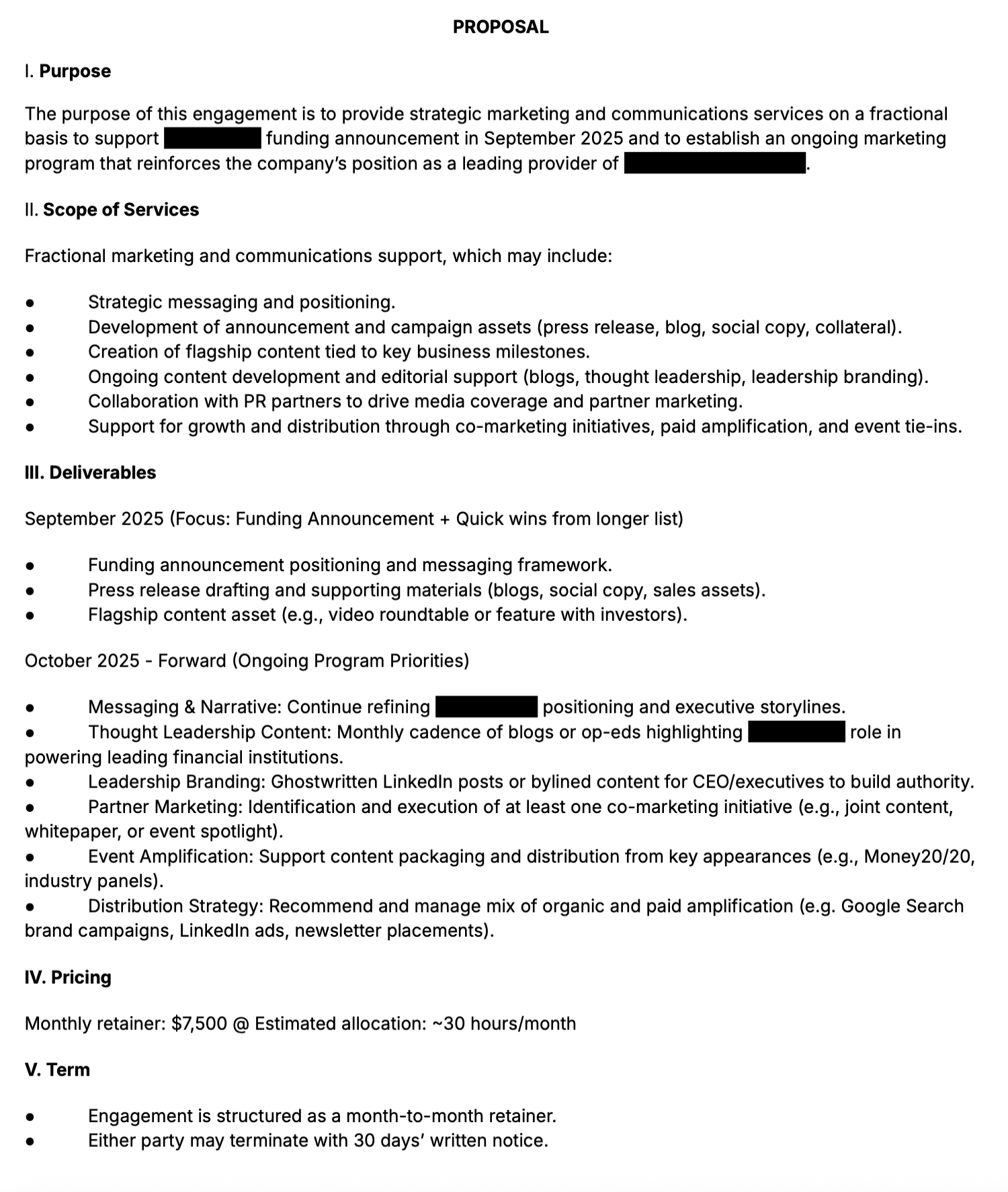
This proposal hits all of the key criteria for a successful proposal.
- A clear statement of purpose. This could also be a “problem statement”.
- A short and sweet scope of work. Notably, the scope describes key activities but is otherwise quite vague. That’s okay! Especially if the client doesn’t quite know what they want.
- Specific deliverables for the client to visualize what value they’ll be getting (and not getting).
- A timeline, which in this case is intertwined with the deliverables.
- Compensation, described as a monthly retainer.
- A rough estimate of time allocation per month (notice the ~).
- Communication around what termination looks like. In this case, 30 days mutual cancellation (14 is also common).
A Fractional HR Director Proposal (link here)
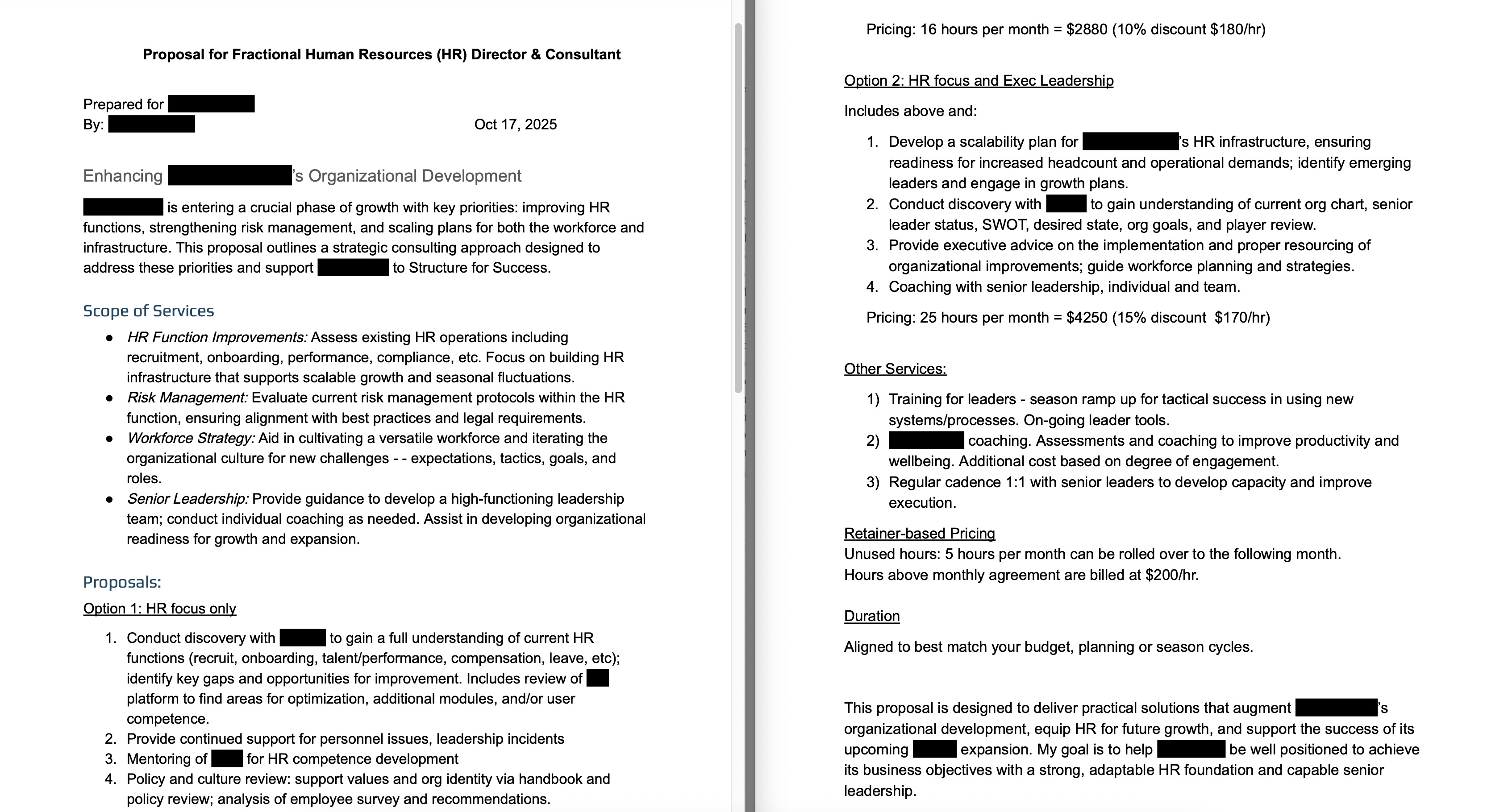
Again this proposal includes all the important stuff. Let’s call out some of the more interesting aspects of this proposal:
- It includes different options, with different scopes and price points. This is great when the client is unsure what the right level of commitment is for them. Two options is fine, even three, but never show more than three options.
- It includes language that covers hourly pricing in the event the scope exceeds the 16 or 25 hrs per month retainer. That’s the sign of an experienced fractional leader right there!
- This fractional HR leader decided that if the client didn't use the allotted hours in a month, up to 5 hours could roll over to the next. This is a personal preference, and not necessarily standard, but a good example of how in the fractional world you can set your own rules.
How Detailed Should the Proposal Be?
The proposal should be detailed enough to give the client a clear picture of what they’re buying. But, it should not be so detailed that it creates unnecessary rigidity in the relationship. Priorities and goals change constantly, a proposal that is too detailed can actually work against you.
A good rule of thumb is that the proposal should be as detailed as the client’s problems are. Every client has different needs, some more defined than others. If you’re pitching a potential client with a very vague understanding of the problem and solutions needed, the proposal should be similarly high-level.
Your scope does not need to be exhaustive, either. It should offer a really good sense for where you’ll be focused in the beginning, but it’d be unreasonable to predict what work needs to be done 180 days out, so don’t even try. You and your client should accept the fact that the scope will change as the relationship develops.
Proposing a Trial
It's quite common to start off a fractional relationship with something like a one-month trial. It's low risk for the client, and therefore many fractional leaders find it an easy way to get their foot in the door to prove value.
If you're proposing a trial phase, the same principles in this Playbook apply. You might make some small tweaks to your approach, like:
- Being quite specific in your deliverables, since it's easier to know what needs to be done in the first month.
- Make the scope more focused on an "audit", where the learnings then inform a larger future scope of work.
- Be crystal clear about what success looks like. After all, you're essentially using the trial to convince the client to commit to a longer-term engagement.
- Cover what happens at the end of the trial. Does the contract auto-renew unless cancelled? Will you scope out a new phase together? Are there differences in your compensation for a longer engagement that you want to set expectations on in the trial period?
Starting with a trial probably means a shorter, more straightforward proposal too. It optimizes for getting into the work itself, vs. spending too much time discussing what the work should be in theory.
Things to Avoid
Some common proposal mistakes from fractional workers include:
- Sending a generic proposal that you send to all clients. If it’s not tailored to your specific client, you decrease your chances of closing the deal.
- Sending a proposal too soon. If the client isn’t ready to receive a proposal, you risk “jumping the gun”. If you’re unsure, ask the client on a call, “would it make sense for me to send you a proposal as a next step, and then we can discuss further?”
- Sending a “menu” of services as your proposal. It’s not customized, and it feels impersonal. You CAN walk clients through your service options, and then once you know where they’re leaning, put together an actual proposal.
- Pretending to be SaaS software with different subscription tiers. You’re not SaaS. You’re human. That’s why you’re being hired. Lean into being human, and customize your offering.
–
That’s it! Remember, all of this can be done in as simple as an email and a couple conversations with a potential client. It doesn’t need to be a huge amount of work. If you follow this Playbook, you will increase your chances of closing clients, and you’ll be setting your relationships up for success from the start.
If you want more fractional clients, as well as other best practices on building a successful fractional practice, check out Fractional Jobs.
What to Read Next
Want to Read More?
Send fractional jobs,
playbooks, and more to

.svg)
.svg)
