Office Hours, June 11th: 13 Interesting Questions About Fractional Work, Answered by Taylor Crane
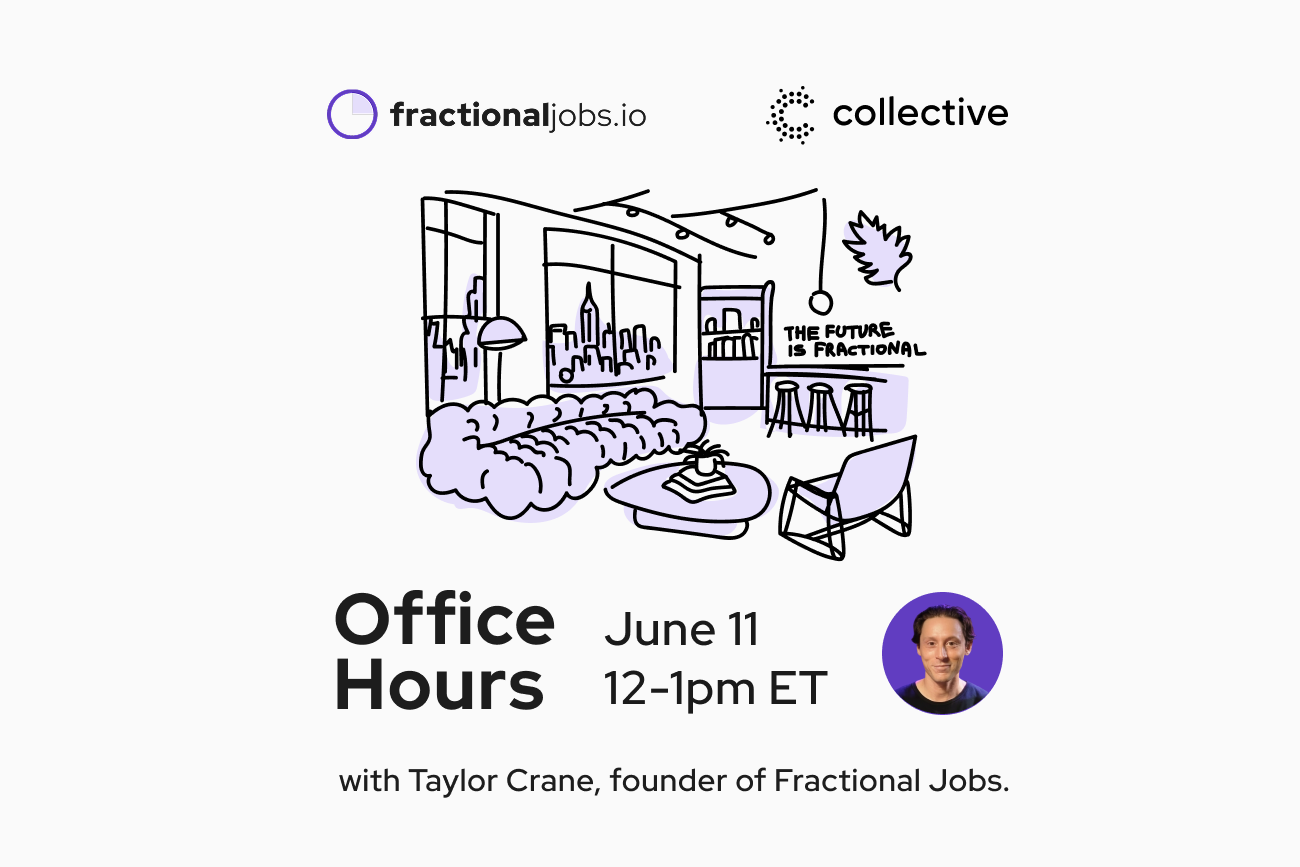
On June 11, 2026 I hosted my first-ever Office Hours with the Fractional Jobs community. It was supposed to be 60 minutes, ended up being 90 min! Everyone came with questions about fractional work and I did my best to answer on the spot. It's a format I've wanted to run for a long time, and it was a blast.
We had a ton of great questions, so I pulled the best ones together with my answers below. Whether you're just getting started or you've been doing this for years, there should be something in here for you.
How do you show a client you're worth what they're paying you?
Liz asked this one. She's just starting out and wanted to know how you prove your value when you're only working for the client a few hours a week.
The weekly recap email. It's my #1 move. Every Friday, I'd send each client a short note: here's what I got done this week, here's what's next. It does two things. It lets them reprioritize on the fly, and it kills the biggest fear companies have about fractional, which is "can someone really do much in 10 hours a week?" When they see five real things you knocked out in 10 hours, that fear disappears. It became a point of pride for me. Five things in 10 hours that a full-timer might take a 40-hour week to do.
For more reading on this, check out How to Provide Weekly Updates to Your Fractional Clients.
What are you seeing in terms of demand, both which functions and which kinds of companies?
Monica asked this. She's a fractional CFO and wanted the view from the demand side.
Top three functions are CFO, CMO, and CTO. CFOs are #1 because they were the original fractional role, so there's just way more awareness there. CMOs are right behind, and CTOs round it out (though my network is biased toward tech startups). I'm also seeing more heads of sales and HR lately, which is great. On the company side, it's almost always small businesses and startups. There are really only two reasons to hire fractional: you don't have the need for a full-timer, or you don't have the budget. Early-stage companies usually have one or both. One nuance: some functions like CFO and CISO stretch nicely into later-stage companies. Others, like marketing, don't. I can't picture a 100-person company without full-time marketing leadership.
For more reading on this, check out What Are the Most Common, and Least Common, Fractional Roles?
I gave my first client a discount. How do I raise my rate without blowing up the relationship?
Michelle asked this. Her first client is open to extending, and she knows she's priced too low.
First off, your instinct to take the discount and get client reps in was right. For next time: when you discount, call it out upfront and tie it to a trigger. I once told a client "I'll take 20% off until you raise your seed round, then rates go back up." Clean and built-in. For where you are now, two things matter most. One, give advance notice, like "heads up, in three months XYZ," never "effective next week." Two, pair it with leverage. Leverage beats "let me show you my value" every time. Leverage is a concrete reason the rate is going up: you've got more clients now, you're charging them more, you've gone deep on something new.
For more reading on this, check out How to Increase Your Rates.
What's the typical length of a fractional contract?
Steve asked this. He's an ethics and compliance officer juggling annual agreements and shorter project work.
I give two answers. For high-growth startups, it's often 6 to 9 months, maybe a year, then they do well, outgrow you, and need a full-timer. Small businesses grow slower, so I see those run a year, 18 months, two-plus. It really comes down to how fast the company grows and when they outgrow the fractional. And for work like yours, starting on a project basis and then transitioning into a low-hour ongoing retainer makes a ton of sense. It won't be a standard 10-hour-a-week deal. You build something custom that works for both sides.
For more reading on this, check out What Fractional Contracts Typically Look Like.
Clients keep pushing me into hourly instead of a flat monthly fee. How do I handle that?
Steve also asked this. His clients want to treat him like outside counsel, billed by the hour.
Hot take: I actually advocate for time-based monthly retainers too. Tie the retainer to a set number of hours per week. I think fractional work is time-based work, and pure value-based pricing doesn't really apply here. So I get the hirer's side. As a founder, I hate paying for a resource I'm not using. When your work is lumpy and up-and-down, anchoring on transparent hourly time feels mutually fair to them. That doesn't mean you have to do it. This is where leverage comes back: the more clients and pipeline you have, the more you can set the terms. "This is how I work, here's the minimum, here's what happens when it scales up." That's your right to negotiate. But I do empathize with the hirer here.
For more reading on this, check out Should I Charge an Hourly Rate, a Monthly Retainer, or Something Else?
My role isn't a common fractional one. How do I find companies that need it?
Dominique asked this. He works in leadership development and is eyeing a fractional Chief Learning Officer path.
When you look at any job board, including mine, you're seeing the tip of the iceberg, the roles that bubble up into the public sphere. Most fractional work happens below the waterline, through networks and referrals. So not seeing your role posted doesn't mean the demand isn't there. It just means it's harder, and the ball is more in your court to go find clients. The less common your role, the truer that is. The way through is talking to people, colleagues, friends, anyone ICP-adjacent, and iterating on your pitch until something resonates. Our survey found 94% of fractionals landed their first client through their network. That's the game. And if you're working your network hard and clients still aren't coming, that's a signal your offering or positioning needs tweaking.
For more reading on this, check out Why Don't I See any Fractional Roles for Me or My Function Area?
With the economy and layoffs, are companies replacing teams with a fractional leader plus juniors?
Jill asked this. She runs a seasonal business and is exploring fractional marketing work.
Honest answer, I don't have enough data to make a macro call on the economy. But in theory? You're describing exactly how I see it going. The combo of AI and cost-consciousness lends itself really well to hiring a fractional CMO who does the high-value strategic work for a smaller commitment, while AI absorbs some of the junior work. I can tell you Fractional Jobs is growing and demand is up, but my business growing is its own thing, not clean proof of the macro trend. So do I have the data to say definitively this is happening? No. Does everything you're describing match where I think work is headed? Absolutely.
For more reading on this, check out Why is Fractional Work Growing So Quickly in Popularity?
Can a Chief of Staff role really work fractionally?
Megan asked this. She's done fractional CMO and chief of staff work and wondered if such an integrated role can be done part-time.
I believe basically any role can be fractionalized, Chief of Staff included, though I'll admit it tests the limit. The truest definition of CoS is "the CEO can't be in two rooms at once," and that's hard to do part-time. But here's the thing: it's better to have an exceptional Chief of Staff for 20 hours a week than zero. The client we're working with now is a CEO stretched across three business lines who just acquired another company. He wants a trusted person he can deploy anywhere to get things done, and he's not ready to commit full-time budget. My pitch is always the same: the talent you can get fractionally is far better than who you'd land full-time. 20 hours of a great Chief of Staff beats a full-time one you could actually afford.
For more reading on this, check out Can I Hire Someone for Fractional Work That Isn't an Executive?
My intro requests on Fractional Jobs keep getting denied. Am I missing a keyword or trick?
Celica asked this. She's submitted a handful of intro requests on Fractional Jobs and keeps getting passed over.
There are no keywords, we don’t do AI keyword-matching. It's all reviewed by humans. A denial almost always just means the client didn't see the fit, and that's the most common outcome by far.
A few things to know. I write every job description myself, and the "About You" section is the real requirements, not nice-to-haves. If it's a bullet in the requirements, treat it as a requirement. If you genuinely meet them all and still get passed over, that's just marketplaces being picky and subjective (same frustration with dating apps). It doesn't mean you wouldn't crush the job. It doesn’t mean you wouldn’t crush the job. It just means the client felt like someone else’s background might be a slightly better fit.
If you got a rejection email and you’re frustrated, reply to it. It comes straight to me, and I personally dig into why for dozens of people every week.
Last thing: write your intro as a human. Take 5 to 10 minutes, type it yourself. Don't use ChatGPT, it's painfully obvious.
For more reading on this, check out How to Submit a Great "Intro Request" on Fractional Jobs.
How do you get up to speed on a business fast enough to add value quickly?
Katie asked this. She wanted to know how you onboard into a new client fast, and whether AI helps.
There's no single answer, and honestly, this is your secret sauce, so build your own version of it intentionally. Here was mine: I kicked off every engagement with a one-hour "founder interview." I show up with a pile of questions about their business, their mindset, what keeps them up at night. Founders love talking about themselves, it's like putting them on a podcast, and it informs everything about how I work with them. After that, I just drink from the firehose and hit the ground running. Getting up to speed fast and pattern-matching is supposed to be one of your superpowers as a fractional. Lean into it.
For more reading on this, check out How a Fractional Job Works, in Practice.
What's the best way to package a wide range of skills?
Lindsay asked this. Her skill set spans creative direction, strategy, content, automation, and marketing ops.
Everyone's first instinct is to go broad and be everything. Then they hear "niche down, pick a lane," which is directionally right but creates a new trap: picking a lane too early. My advice is to let your positioning emerge from the work instead of staking it out up front. When I did fractional Product work, my line became "Fractional Head of Product for early-stage startups with non-technical founders." But I didn't invent that and go chase it. I noticed my first three clients were all non-technical founders, realized I was adding a ton of value there, and that became my box. A lot of people plant a flag too early, watch the clients not show up, then have to awkwardly walk it back publicly. Take steps, iterate, let it emerge.
For more reading on this, check out How to Position Yourself to Attract Fractional Work.
How do you narrow in on your sweet spot when you're on your own?
David asked this. He's doing fractional product management with one client and building out his offer.
Your first client came from an ex-founder in your network, and they hired you regardless of your one-liner. That's the easiest path, so go find a couple more like that. Then let your positioning emerge from the actual work, same as I told Lindsay. And when a friend offers to forward your blurb to someone specific, treat it like an experiment. Write a version hyper-positioned for that exact person and see if it lands. Same with the one-pager you're building: don't chase perfect. Pick a position you think is interesting, ship it, and see if it resonates. If it does, that's important data.
For more reading on this, check out How to Get Your First Fractional Clients.
What's demand like for fractional COO / ops roles, and are retainers or projects more common?
Michael asked this. He wanted the read on operations roles in startups and SMBs.
Demand for ops is growing, but it's not top-tier popular, and here's why. The most popular roles (marketing, finance, engineering) are ones where a founder's instinct is to hire externally to fix the gap. I call that Level 1 fractional hiring. Ops is Level 2: when a founder feels operational pain, their default is to do it themselves or tap an internal person (same thing happens to product). So it's a bit harder, but there's plenty of COO work out there, so don't be discouraged. This holds across both startups and SMBs. It's about founder instinct, not company type. On structure: for ops, retainers make natural sense because the work is constant. But starting with a project, like an audit or a system overhaul, is a great on-ramp. Once your value is obvious, the ongoing retainer conversation becomes a lot easier.
For more reading on this, check out Hiring a Fractional COO.
How long should it take to land your first client?
Katie asked this too. She's on day five of building her consulting business.
My rule of thumb: give yourself three months. Three months of really working your network, having conversations, pitching yourself, chasing leads. If you haven't landed a client by then, and let's define "client" as 5+ hours a week for more than a month, that's your moment to pause and reflect. Not quit, just reflect: is my offering off? Am I using my network right? You're on day five, so breathe. Make a real commitment to give it three months, and stop questioning yourself every single morning. (And I don't buy the "summer is slow" thing, it's never resonated with me.)
For more reading on this, check out How to Get Your First Fractional Clients.
That's a Wrap!
This was a super fun Q&A session for me. We're running Office Hours again in July and August, so keep an eye out if you want to bring a question to the next one.
The whole Office Hours series is presented in partnership with Collective.com, and I'm super grateful for them. If you're at the point in your fractional practice where you need to set up your LLC or S Corp and start taking your business more seriously, you should learn about how Collective can help.
What to Read Next
Want to Read More?
Send fractional jobs,
playbooks, and more to

.svg)
.svg)
