How to Get $30k-$100K in Paid Family Leave in California - and the 7 Mistakes to Avoid
Diane Gatza, P.E., CLMS is the founder of California Maternity Leave Consulting.
If you run your fractional practice through an S-Corp and pay yourself through payroll, you’re already automatically enrolled in the most generous paid leave systems in the country. Sadly, most fractionals have no idea. The ones who find out late usually collect a fraction of what they could have.
I’ve helped 6,000+ California families through their leaves, hundreds of them business owners. These are the seven mistakes I see cost fractionals the most money, and paid time with your newborn that you can’t get back, ranked by how much they cost. Each one is also a hidden advantage of working for yourself, if you catch it in time. Maternity leave is all we do. Let us make sure you collect every benefit you’ve already paid for.
Why fractional leaders are different
When you're a corporate W-2 employee, your employer automatically enrolls you into the state system and your benefits are calculated from your bi-weekly paycheck. Simple.
When you own your business, the math changes. Business income does not equal maternity leave income. What the State actually looks at depends on:
- How your business is structured (1099, LLC, S-Corp, C-Corp, LLP)
- How you pay yourself, and whether you're on payroll
- What you've actually paid into the state programs
- Your income history during the State's lookback period
- When you start planning
That's why two fractional executives earning the exact same amount can walk away with completely different outcomes: one collecting tens of thousands of dollars, the other getting denied.
Where the 30-100K comes from
California's paid leave isn't one program. It's a stack. For business owners, the key pieces are:
- SDI (State Disability Insurance): pays up to 52 weeks during pregnancy disability and recovery after birth
- PFL (Paid Family Leave): pays you up to 8 weeks to bond with your baby, and your partner can claim it too
- DIEC (Disability Insurance Elective Coverage): the path for many 1099 contractors and LLC owners who aren't on payroll to receive up to 39 weeks of pay
Which of these you can use depends on your structure. In general, S-Corps, C-Corps and LLPs can enroll in SDI through payroll. Sole proprietors, 1099 contractors and many LLCs need to elect into DIEC. Some fractionals also qualify through ad-hoc contract employment.
Here's what's at stake if you miss it:
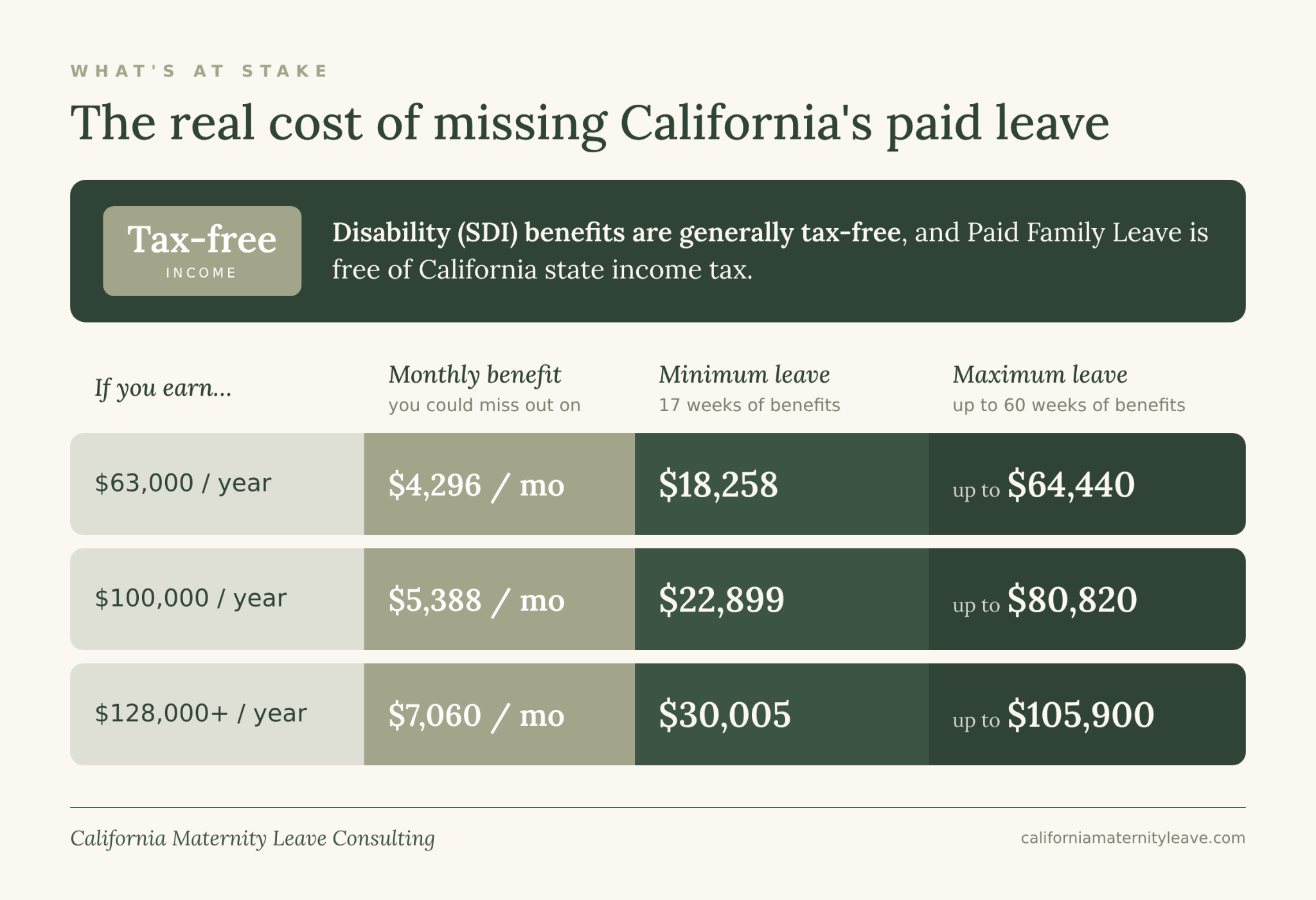
Stack those weekly benefits across pregnancy, recovery and bonding, add your partner's eligible leave, and $30K is a conservative outcome. $100K+ is very real for households that plan their benefits early.
The 7 mistakes fractionals make when planning maternity leave
1. Assuming paid leave left with your last W-2
“Paid maternity leave is for people with employers.” I hear this on almost every intro call.
Most fractionals miss this: if your LLC is taxed as an S-Corp and you run payroll for yourself, you are a W-2 employee of your own company. Every paycheck you run through Gusto, ADP, Justworks or another provider already withholds 1.3% for California State Disability Insurance (SDI). You’ve been paying in, so you’re covered by both of California’s programs
If your LLC is taxed as an S-Corp and you run payroll for yourself, you’re already ahead of most fractionals, and you may not even know it. That setup wasn’t just a smart tax move. It quietly made you a W-2 employee of your own company. Every paycheck you run through Gusto, ADP, Justworks or another provider already withholds 1.3% for California State Disability Insurance (SDI). You’ve been paying in all along, which means you’ve already earned your way into both of California’s programs:
- Disability Insurance (SDI): pays you during pregnancy and recovery. That’s typically up to 4 weeks before your due date and 6 to 8 weeks after. It runs longer if your provider certifies you still can’t work.
- Paid Family Leave (PFL): up to 8 more weeks to bond with your baby. Your partner gets their own 8 weeks.
Both pay up to $1,765 a week in 2026.
The fractional advantage: a corporate employee qualifies for the same benefits, but they have to negotiate how long they can actually be gone. You’re the employer. Nobody can deny your leave, cap your time off, or quietly replace you for taking the full year.
Quick check: Do you live in California? Is your LLC or corporation taxed as an S-Corp? Do you run W-2 payroll for yourself? If all three answers are yes, you qualify. If you’re a sole proprietor or a single-member LLC without an S-Corp election, your path is the State’s elective coverage program, DIEC. It requires a different playbook.
2. Assuming leave means letting every client go
Most fractionals think it’s all or nothing: go fully dark, or keep working and give up your benefits. It isn’t.
California allows partial disability. If you work reduced hours while you recover, you don’t have to give up your tax free benefit income. Done right, many of our clients keep a flagship client at 5 to 10 hours a week and still collect their max weekly benefits. If you’re not set up correctly by your second trimester you may lose this option completely and need to let go of all of your clients until you return from leave.
Done wrong, it’s brutal. A partial claim means reporting your hours and wages every two weeks, plus a separate set of employer forms from your own S-Corp. If those forms are set up incorrectly, working even two hours can drop your benefit approximately 90%.
The fractional advantage: fractional work already runs in 3 to 6 month sprints. You can roll off most engagements, keep the one that matters, and use the quiet stretch at the end of your leave to rebuild your pipeline. No corporate employer offers that.
Case study: Fractional consultant and coach. She runs a seven-figure practice and had several clients she didn’t want to lose. We identified her critical clients, structured a partial leave around them, and kept her business earning under its own EIN. Result: over $100,000 in leave income, with her key clients still in place.
Do this instead: Before your leave, sort every client into pause, hand off, or keep. Then build your payroll and your claim around that plan, not the other way around.
Want to get set up to claim max benefits and retain the ability to hold a client? Let’s connect.
3. Starting the clock at the positive pregnancy test. Back pay isn’t a strategy. It’s a rescue.
The State calculates your benefit from wages paid 5 to 18 months before your leave starts. So the quarters that decide a mid-2027 baby’s benefits are happening right now.
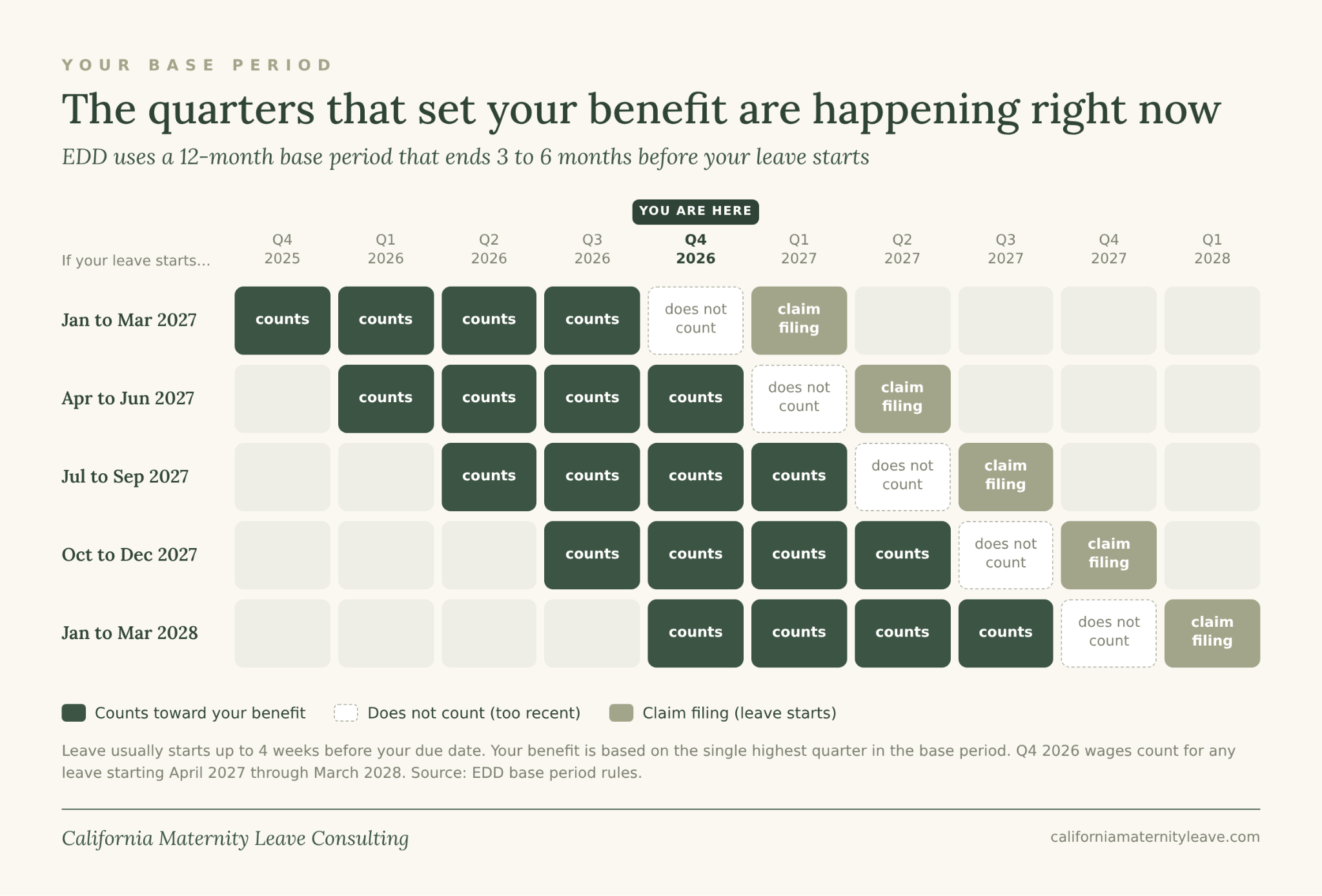
Find the row for when your leave would start, usually about 4 weeks before your due date. The green cells are the only quarters the State will look at. Q4 2026 wages count for any leave starting between April 2027 and March 2028. If a baby is in your plans for that window, this quarter may be your best chance to set your number.
Here’s how it usually goes wrong. Someone gets pregnant in August 2026, is due in May 2027, and starts researching leave in February, in her second trimester. Her benefit is based on 2026 wages, and 2026 is closed.
Sometimes you can fix it after the fact with back pay. Once the year closes, you’re into amended W-2s, amended quarterly payroll filings, and a lot of time on hold with the State. It frequently doesn’t work. I’ve handled more of these appeals than I’d like to count. Back pay isn’t a strategy. It’s a rescue.
Do this instead: Plan your payroll before you’re pregnant, or in the first trimester at the latest. Treat it like hospital indemnity insurance, which you set up during the benefits year, before you need it. If you want to change Q4 2026, we need you onboarded by early-December so payroll can run before December 31.
Already expecting and closing in on your timeline? Let’s connect.
4. It’s not how much you make. It’s how you pay yourself.
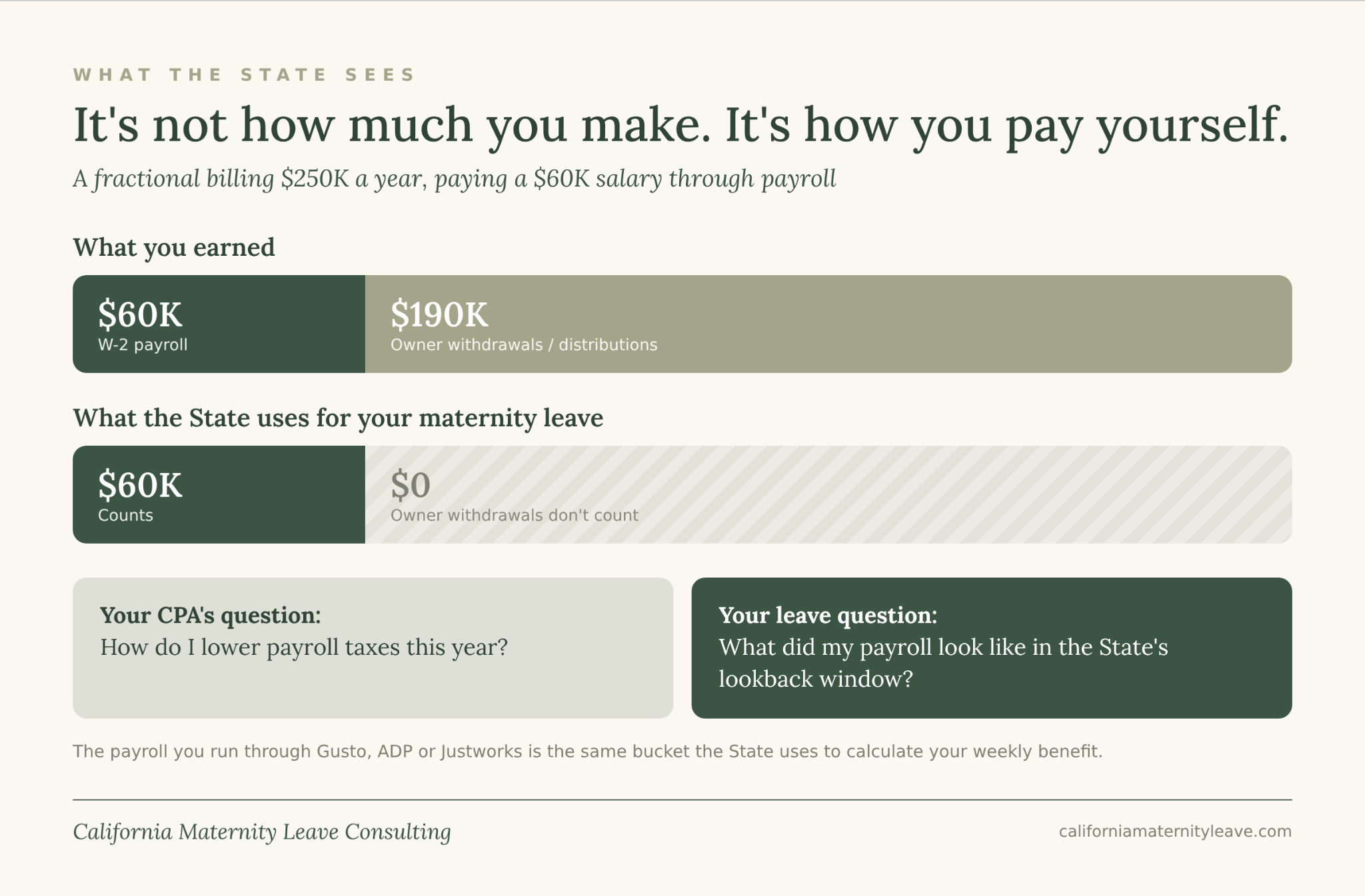
Say you make $250K a year across all of your clients. If you take most of that as owner withdrawals instead of W-2 payroll, the State doesn’t see $250K. It only sees the payroll. That’s the number used to calculate your benefits, and owner withdrawals count for $0.
As an S-Corp, your accountant probably told you to blend the two: some payroll, some owner withdrawals, for the tax savings. That’s a great tax strategy - it just needs to be aligned with your maternity leave strategy. The payroll bucket you run through Gusto, ADP or Justworks to save on taxes is the same bucket the State uses to calculate your maternity leave. If you pay yourself a $60K salary and take the rest as withdrawals, the State sees you as having made $60K.
Case study: Fractional COO. Her CPA kept her salary low, so she assumed she’d collect almost nothing. We restructured her existing payroll and added strategic solo 401(k) contributions. Result: ten months off and over $80,000 in tax-free income, versus about $30,000 on her original setup.
Do this instead: Open your payroll provider and pull your gross W-2 wages for 2025 and 2026. This is your starting baseline to calculate benefits for your maternity leave. Use the State’s calculator to see what your baseline income would qualify you for. If it’s less than the max of $1,765 a week you are leaving benefits on the table and could use a restructured strategy to ensure you collect maximum weekly and annual payouts.
Want a payroll review to make sure you’re not leaving anything on the table? Let’s connect.
5. Assuming your CPA has your maternity leave covered
Your CPA probably set up your LLC or S-Corp to minimize taxes, and that's exactly their job. They're great at it. But tax optimization and leave optimization can pull in opposite directions.
Take the most common S-Corp move: paying yourself a modest "reasonable salary" and taking the rest as distributions. It lowers your payroll taxes. It can also shrink the income the State uses to calculate your benefits, sometimes by half or more. Your CPA saved you a few thousand dollars in taxes, and nobody mentioned it could cost you far more on leave.
The timing is different too. Tax planning and calculations run on an annual cycle, so January - December. Maternity leave planning runs on a rolling 18 month lookback, because the State looks back at your income history and your enrollment before you file. By the time some factionals look at and assess their W2 income and owners distributions at tax time, the window to change for the state's maternity leave program may have closed.
And processing a maternity or paternity leave claim is in a world of its own. The claims run through the EDD, not the IRS, with their own forms, rules and appeals. Maternity and paternity leave claims are being filed as insurance claims, not tax forms based on income.
Do this instead: Keep your CPA for taxes and bring in a leave specialist for the maternity leave claim strategy and filing. Best approach - get them together before you change your salary or structure, so your tax plan and your leave plan work together instead of against each other.
Get expert help. Book a call.
6. Setting up your corporate entity without thinking about leave
Most fractionals form an LLC or elect S-Corp status in their first few years, usually on a CPA's advice or because a peer did it. Once it’s set up some never revisit it. The structure made perfect sense for taxes and retirement planning so no one asks what it means for a future maternity or paternity leave.
Here's why it matters for you: your entity decides which State program you can even use. In general:
- S-Corps, C-Corps and LLPs can pay into SDI through payroll, the same way a W-2 employer would.
- Sole proprietors, 1099 contractors and many LLCs aren't automatically covered. They need to elect into DIEC (Disability Insurance Elective Coverage), which has its own enrollment rules and minimum commitment.
- Some fractionals also qualify through contract employment with a client, depending on how that engagement is set up and if a W2 is involved.
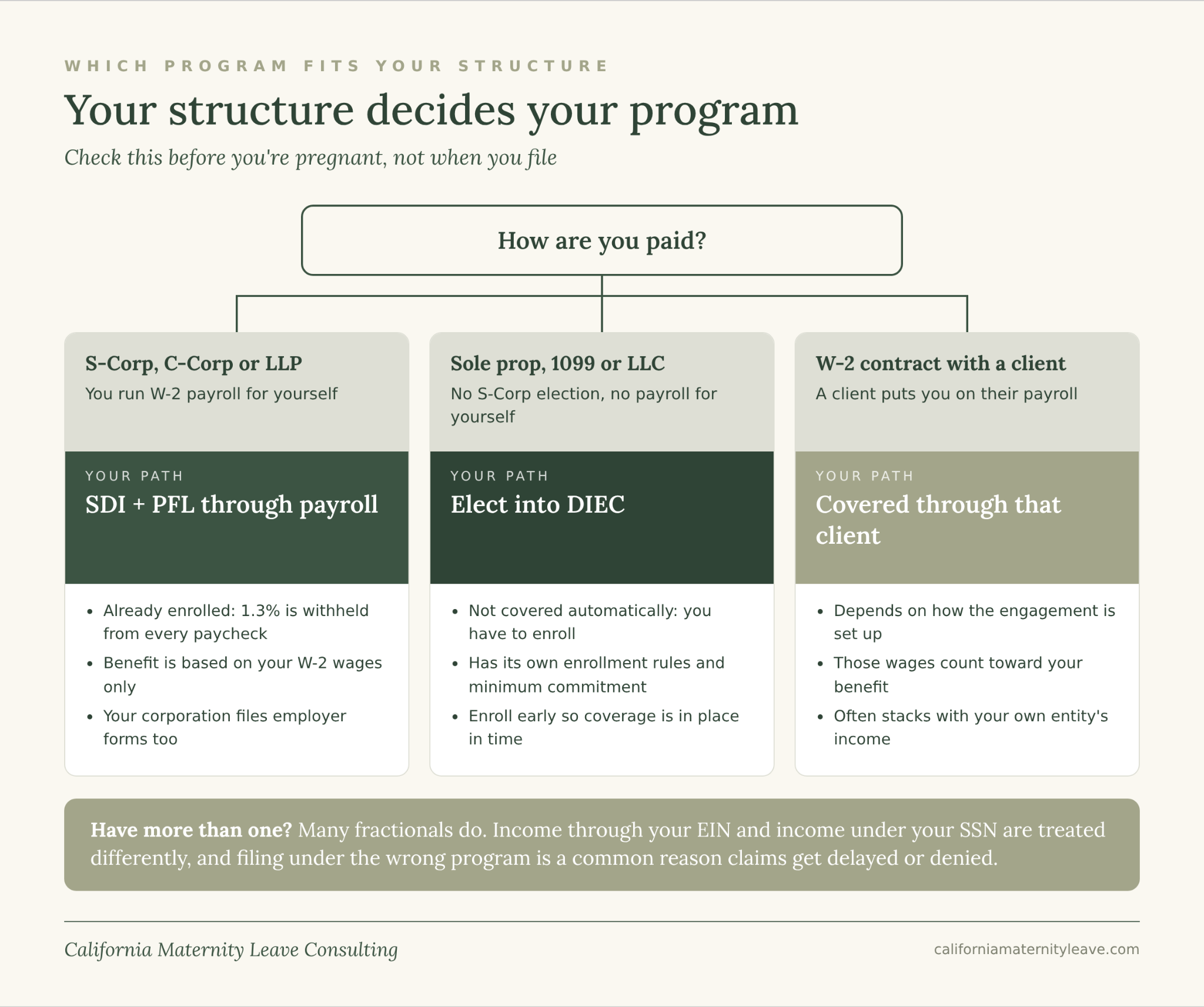
It also matters which clients run your pay through your business's EIN and which clients run pay under your own SSN. Many fractionals have both: a main client billed through the S-Corp, a side advisory gig paid to them personally. Each carries different requirements for paperwork, claims, what counts for benefits and how much you can work while collecting. Mixing them up is one of the most common reasons a business owner's claim gets delayed or denied is filling out a claim with the wrong program based on your business structure.
Do this instead: Review your structure through a leave lens before you're pregnant. Confirm which State program your entity can use, make sure you're actually enrolled in it, and how your EIN and SSN income will be treated. If a change is needed, making it early gives it time to count or you might be outside your window of opportunity to make changes.
Want to make sure you’re set up correctly? Let’s chat.
7. Forgetting the money is tax-free, and your partner counts too
Two things almost never make it into the math.
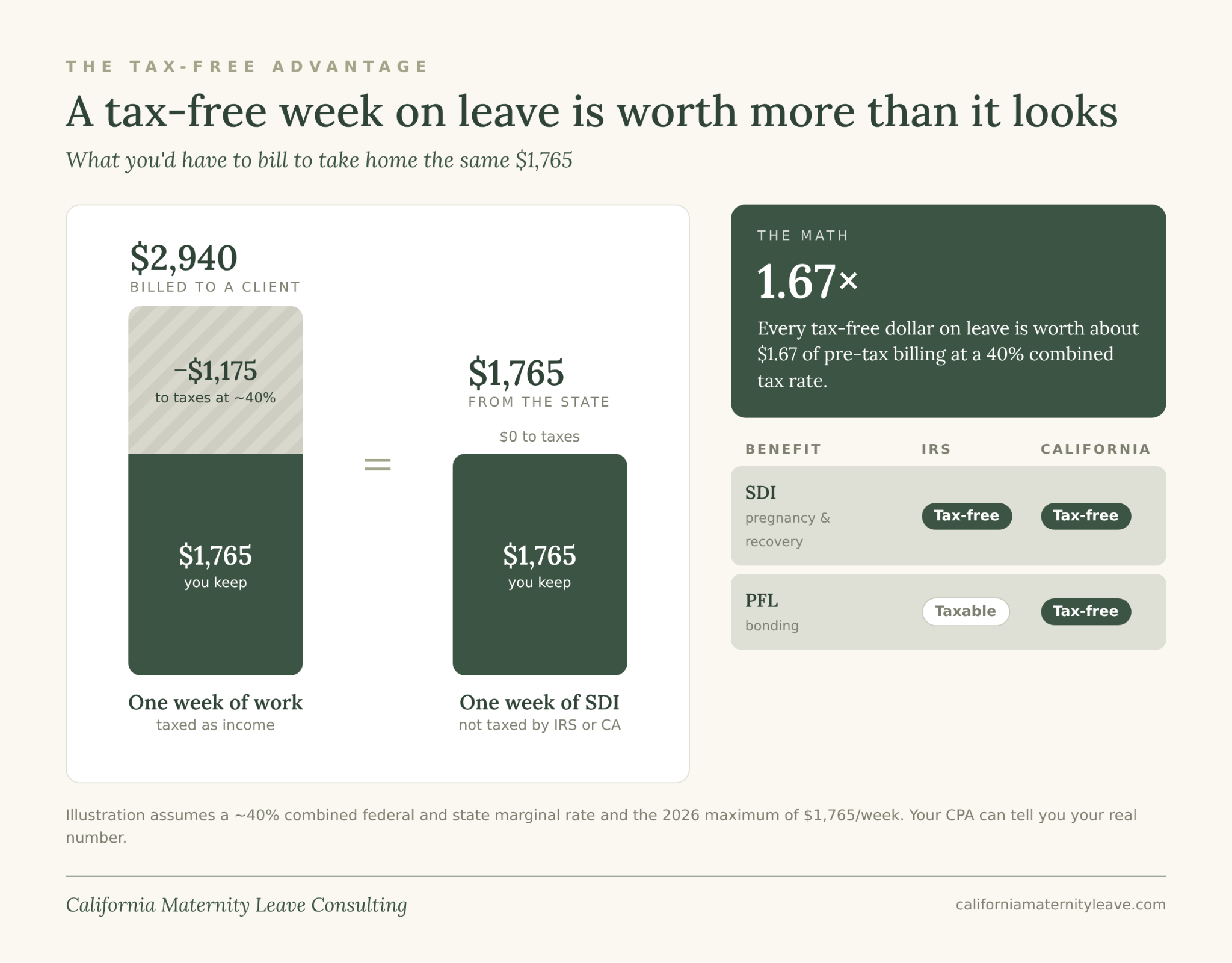
It’s mostly tax-free. Disability benefits aren’t taxed by the IRS or California. Bonding (PFL) is California tax-free but federally taxable. If your combined marginal tax rate is around 40%, a tax-free $1,765 week is worth what roughly $2,940 of pre-tax billing would net you. That’s about $12,700 a month in pre-tax terms. Your CPA can tell you your real number.
It’s a household strategy. Your partner can claim their own 8 weeks of bonding. If they’re a W-2 employee earning $120K+ elsewhere, they’re likely already at the max. If they aren’t, and they do real work in your business, putting them on your payroll can qualify them too. Dads, this means you.
Case study: Fractional CFO. He didn’t think dads qualified for anything. We made him eligible while he kept some clients going. We also structured payroll so his wife, who works in the business, qualified through his company. Result: over $14,000 for him and over $44,000 for her. Without early planning, she’d have received nothing.
Do this instead: Plan both parents together, and run the numbers after tax. The household total is usually what gets a skeptical spouse on board.
Why “I’ll just file it myself” gets expensive
You can file on your own, and people do. But a business owner’s claim has three sets of paperwork that all have to agree: yours as the employee, your corporation’s as the employer, and your medical provider’s. Add partial disability, extensions, and a partner, and there are many more places for it to break. Small mismatches lead to denials, underpayments, or overpayments the State claws back months later.
Most of what you’ll find on Reddit, in Facebook groups, or from AI is written for W-2 employees at someone else’s company. We’ve filed 500+ successful State claims and handled 100+ special-case appeals. This is all we do.
Get expert help. Book a call.
The Q4 2026 window closes December 31
If a baby is in your plans for 2027 or 2028, the payroll you run in the next ten weeks may decide what you collect. Here’s what to do this week:
- Pull your W-2 wages by quarter from your payroll provider.
- Find your monthly payroll and use the State’s calculator to get your weekly benefit
- Multiply your weekly max from the State’s website by 60 and if it’s less than $100k you have room to optimize
- Book a benefits call. We’ll tell you your minimum, your maximum, and exactly what to change before year-end. Bring your partner.
Diane Gatza, P.E., is the founder and CEO of California Maternity Leave Consulting. A licensed engineer, she turned her own two California maternity leaves into a company that has helped 6,000+ families, with a specialty in business owners and complex claims.
Figures use the 2026 California SDI and PFL maximum of $1,765/week. Results vary. Your eligibility and benefit amount depend on your income, payroll setup, medical certification, and State rules. Case study details changed for privacy.
What to Read Next
Want to Read More?
Send fractional jobs,
playbooks, and more to


